What should drive the choice?
Choose the 5P1500RC when its shorter body, ten outlets or 1,100W limit address a documented need. Choose the SMT1500RM2UC when 1,000W, six outlets and the APC management path fit. Neither is an online UPS.
Research based on manufacturer documentation. We have not physically tested this equipment.

Check the exact equipment
Amazon.com model searches can include alternatives. Confirm the full model, electrical configuration, seller, condition, included hardware and warranty.
Start with the cabinet and the real load
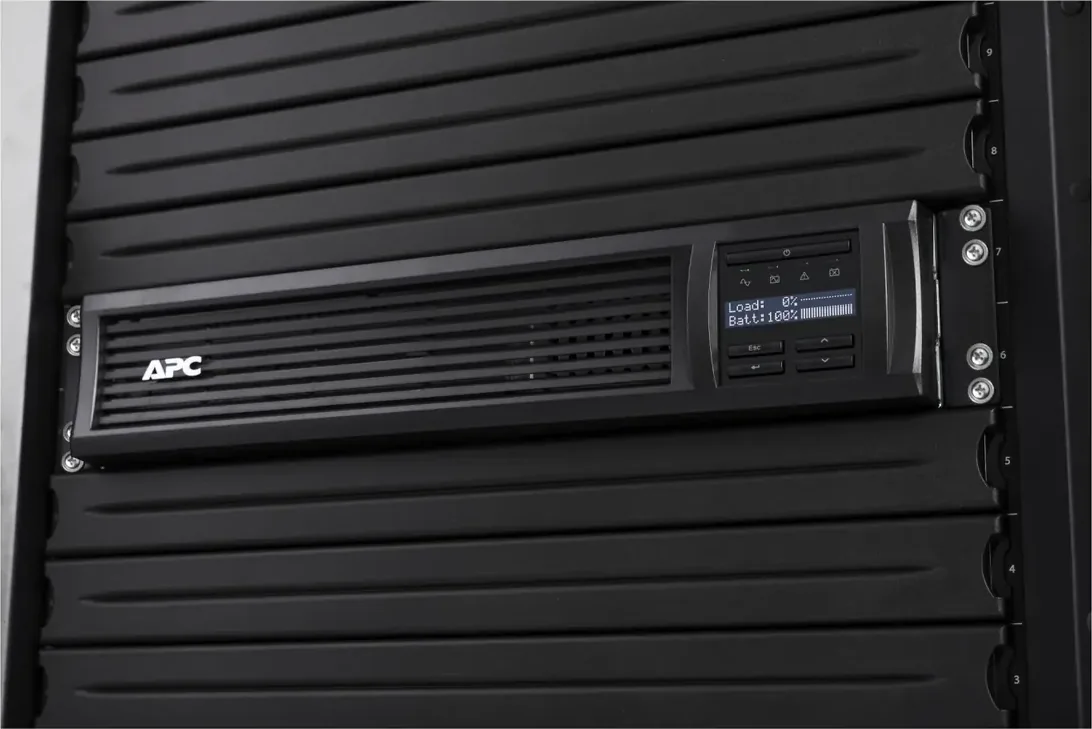
The APC SMT1500RM2UC and Eaton 5P1500RC can appear in the same small-rack quotation, but the useful comparison begins with the cabinet rather than the brand. Both are line-interactive US 120V rack UPS options. The Eaton is particularly relevant when a buyer has limited usable depth. The APC can remain suitable when the rack comfortably accommodates its body and six direct connections are enough. A photograph of a neat front panel cannot settle either of those questions.
This is a comparison of manufacturer specifications and their buying consequences. We have not mounted either unit, discharged its batteries or evaluated its management interface. The recommendation therefore concerns documented fit, not tested reliability. Bring three numbers to the shortlist: the planned real-power demand, the planned apparent-power demand and the actual front-to-rear support distance. Add a list of every load cord. Those inputs can eliminate a candidate before cloud monitoring or seller promotions become relevant.
The two watt ceilings are close, but not identical
The SMT1500RM2UC is rated at 1,440VA and 1,000W. The 5P1500RC is rated at 1,440VA and 1,100W. Both limits must be met independently. A shared 1500-family description does not turn the APC into a 1,500W unit, and the Eaton does not acquire extra apparent-power capacity because its watt rating is higher. Keep the exact US SKU on the worksheet so a regional substitute or a different suffix does not change the comparison unnoticed.
For an invented planning example, a 900W load leaves 100W below the APC watt ceiling and 200W below the Eaton ceiling. Those are simple differences against a single rating, not recommended operating margins or runtime estimates. A planned 1,050W load crosses the APC limit while remaining below the Eaton watt ceiling, but the Eaton still needs sufficient VA capacity and an approved source. If documented growth could reach 1,200W, neither candidate answers that future requirement. Buy around the complete planning scenario instead of treating the small watt difference as a reason to ignore growth.
| Field | SMT1500RM2UC | 5P1500RC |
|---|---|---|
| Rated output | 1,440VA / 1,000W | 1,440VA / 1,100W |
| Nominal source | 120V, NEMA 5-15P | 120V, NEMA 5-15P |
| Direct outputs | Six 5-15R | Ten 5-15R |
| Main fit distinction | Approximately 477mm body depth | 16-inch body depth |
Measure the installed envelope, not just the enclosure
Eaton lists a 16-inch body for the 5P1500RC. The APC source lists approximately 477mm for its chassis. That makes the Eaton worth examining in a shallow cabinet, but it does not establish that it will fit every nominally short rack. Input and output plugs, cable bends, rear doors, vertical managers and battery service access consume space beyond the metal body. Measure the intended orientation with the actual cord route rather than subtracting chassis depth from an advertised cabinet dimension.
Verify the support kit and its adjustment range for the particular rack. The 2U label describes front-panel height, not a promise that two front screws carry the installed weight. A seller may quote mounting hardware without identifying the parts or the supported post spacing. Ask for that information before the shipment arrives. Also record whether battery service can be performed without removing surrounding equipment. A small difference in depth can be valuable when it preserves usable rear access, while a slightly shorter chassis can still be the wrong choice if its connections face an obstruction.
Ten outlets can reduce a distribution purchase, with limits
The Eaton provides ten 5-15R outputs, compared with six on this APC. Count cords rather than boxes. Two dual-supply servers, one firewall, a switch and a management appliance can require seven connections if all of those cords belong on this source. That inventory exceeds six direct outputs without necessarily exceeding the UPS power limit. Conversely, a rack with only four connected plugs can exceed the watt limit. Outlet count and electrical capacity are separate gates.
A separately compatible PDU can address a connection-count problem, but it adds another component, mounting position, source cord and capacity limit. It must also follow the UPS and PDU manufacturers’ installation requirements. Do not treat a consumer power strip as an assumed equivalent. If ten direct outlets meet the approved layout, include the avoided distribution work in the comparison. If the project already needs a managed PDU for remote outlet control, the extra direct receptacles may have less value because the PDU, rather than the UPS back panel, will serve the equipment cords.
Compare the shutdown path that will actually be installed
The APC includes SmartConnect and has local communication and SmartSlot options. Eaton identifies optional network-card capability and local communications for the 5P. A network-capable chassis is not evidence that a particular quoted package includes the card, software or support needed by the project. Separate visibility, alert delivery and graceful shutdown in the requirements. They can involve different services and different dependencies even when a seller calls all of them monitoring.
For a single host, establish whether the supported local communication path is sufficient. For several hosts or a virtualized environment, identify the compatible card and shutdown software, who maintains it and which network devices must remain powered. The source information does not establish that one ecosystem is easier or more secure in your installation. Compare current compatibility documentation and obtain a complete configuration quote. If the site already operates one supported platform well, consistency can outweigh a small hardware difference, provided the electrical and mechanical requirements still pass.
No battery-duration winner follows from these ratings
Use a common watt load when requesting runtime information. Half load represents 500W for the APC and 550W for the Eaton, so two half-load minutes figures would not describe the same demand. Ask each manufacturer resource for the relevant load, battery configuration and estimate conditions. Keep those references separate from the shutdown-time requirement supplied by the application owner. We do not infer minutes from the extra 100W of output rating.
The 5P1500RC does not offer external battery expansion; Eaton directs buyers seeking that capability toward the 5PX G2 family. If the runtime requirement may grow, screen an expandable system now rather than assuming another battery box can later attach to the 5P. The right final shortlist is the one whose complete configuration fits the rack, source, load and service timeline. Confirm the exact carton model, included supports, network options, battery-service parts and seller warranty eligibility before following an Amazon model search to a purchase.
Compare relevant models on Amazon
Amazon.com model searches can include alternatives. Confirm the full model, electrical configuration, seller, condition, included hardware and warranty.
Sources and research basis
- Schneider Electric SMT1500RM2UC specificationsPrimary documentation · checked 15 October 2026
- APC exact-model datasheet (2022 edition; confirm current warranty terms)Primary documentation · checked 15 October 2026
- APC Smart-UPS product and runtime resourcesPrimary documentation · checked 15 October 2026
- Schneider Electric cartridge compatibility and firmware FAQPrimary documentation · checked 15 October 2026
- APC APCRBC159 replacement cartridge specificationsPrimary documentation · checked 15 October 2026
- Eaton 5P1500RC exact US product pagePrimary documentation · checked 15 October 2026
- Eaton complete 5P1500RC specification fieldsPrimary documentation · checked 15 October 2026
- Eaton 5P750RC/1000RC/1500RC installation and user manualPrimary documentation · checked 15 October 2026
- Eaton exact 5P1500RC runtime graphPrimary documentation · checked 15 October 2026
- Eaton battery replacement compatibility in government procurement brochurePrimary documentation · checked 15 October 2026
Thumbnail image credits
- Product photograph: Schneider Electric / APC: APC SMT1500RM2UC manufacturer product photograph
- Product image: Eaton: Eaton 5P1500RC manufacturer product image
Recommendations interpret the linked documentation. We have not physically tested this equipment and claim no original runtime, acoustics, switching or efficiency results. Report a correction.