What should drive the choice?
Choose the PR1000 when its 1,000VA and 1,000W limits meet the entire plan. Move to the PR1500 for a documented capacity need, then compare runtime at common watts and verify the exact mounting package.
Research based on manufacturer documentation. We have not physically tested this equipment.
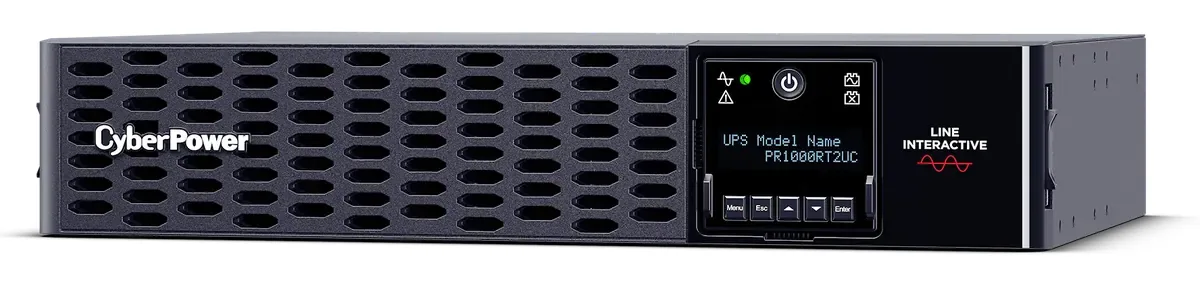
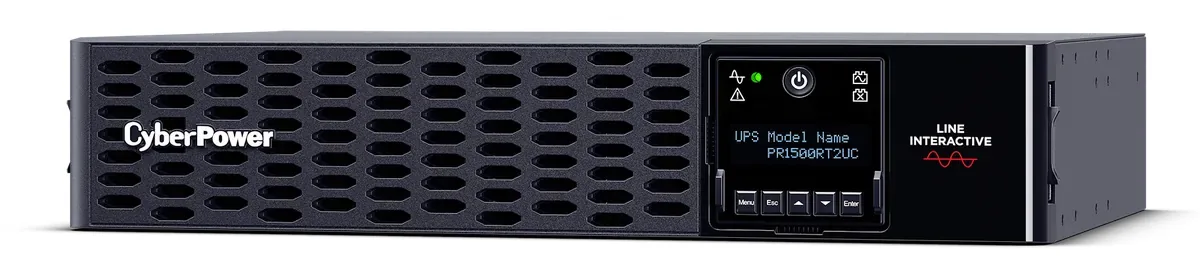
Check the exact equipment
Amazon.com model searches can include alternatives. Confirm the full model, electrical configuration, seller, condition, included hardware and warranty.
A capacity step with a familiar connection format
The PR1000RT2UC and PR1500RT2UC are a useful comparison when a small rack has a compatible 120V source and a load near the smaller model’s limit. Both are line-interactive rack/tower UPS models with eight 5-15R outputs in the cited configuration. The higher model number principally changes the electrical shortlist; it does not eliminate the need to check runtime, supported mounting and management. A customer buying by outlet count alone could miss the entire capacity difference.
Preserve the complete RT2UC suffix on every quotation. CyberPower also uses related RT2U, RTXL2UC and N-suffixed model names. Similar names can represent a different generation, battery-expansion path or card package. The recommendation here concerns the two exact UC models, not a generic PR family. This is source-based analysis, without a physical sample or a measured battery, transfer-time or noise comparison.
Both VA and watts move from 1,000 to 1,500
The PR1000 is listed at 1,000VA and 1,000W; the PR1500 is listed at 1,500VA and 1,500W for the relevant nominal 120V configuration. Verify the manual’s voltage-dependent ratings if the intended operating conditions differ. A unit advertised for a range of nominal voltages does not necessarily retain the same output capacity under every condition. Keep the source and output assumptions attached to the figures used in the purchasing worksheet.
A hypothetical 1,100W planned demand is outside the PR1000’s watt limit. It can remain inside the PR1500’s stated watt ceiling, subject to the apparent-power and installation requirements. At a hypothetical 700W demand, either unit can remain a candidate and the comparison becomes more about the actual shutdown window and complete configuration. Do not turn the 500W rating difference into a recommendation to operate close to a ceiling. Decide the accepted growth allowance and meaningful peak conditions with the equipment owners, then check the resulting values against both ratings.
| Field | PR1000RT2UC | PR1500RT2UC |
|---|---|---|
| Rated VA / W at cited nominal conditions | 1,000 / 1,000 | 1,500 / 1,500 |
| Topology | Line-interactive | Line-interactive |
| Direct outputs | Eight 5-15R | Eight 5-15R |
| Input family | 5-15P | 5-15P |
Match the watt load before comparing battery claims
At half of their stated watt capacities, the two units are supporting different demands: 500W and 750W. A longer published half-load duration would therefore not settle which lasts longer at the same rack load. Use the exact manufacturer runtime resource at the accepted planning wattage. Record the selected configuration, source date and estimate conditions so another reviewer can repeat the comparison. We do not calculate runtime by applying a ratio to the VA number.
The service requirement should be independent of the product chart. Ask the application owner how long event detection, notification, application quiescence and operating-system shutdown are expected to take. Include the network and storage dependencies needed during that process. Then compare the resulting requirement with the manufacturer’s reference duration and the site’s approved validation process. A larger watt rating can solve overload risk while leaving too little shutdown time at the actual installed load. Likewise, a smaller unit with enough capacity can be sufficient when the service timeline is short and well controlled.
Do not infer a four-post kit from the 2U format
Both candidates can be described as rack/tower models, but that is a form-factor statement rather than a complete accessory list. For the PR1500RT2UC, the family manual identifies CP2RAIL02 as a separately purchased four-post rail option. Check the exact PR1000 package and support instructions independently. Two-post brackets, front ears and tower supports should not be silently treated as a supported four-post rail kit. Ask the seller to identify the included parts rather than accepting a photograph of a different bundle.
Measure the rack’s post spacing and usable depth with cable bends and rear-door clearance included. Leave suitable access for the battery service procedure documented for the selected unit. A replacement project may reuse a rack position while still needing different supports or cord routing. If multiple sites are involved, record a site-specific fit check rather than relying on one successful installation to prove every cabinet will accept the same package.
Cloud monitoring and a network card are separate lines
CyberPower describes built-in cloud monitoring and optional RMCARD205 management on the relevant product pages. Clarify what must be visible remotely and how hosts will receive power events. A cloud dashboard is not proof of local shutdown integration, individual outlet switching or a supplied network card. Those claims need exact product and software documentation. If a seller includes a card in a bundle, record its full identifier and supported firmware, not simply the word network.
The family communication restrictions also matter. The reviewed manual notes that USB and serial do not operate simultaneously on the PR1500 arrangement. A plan that connects several independent hosts by assuming every physical port can signal at once can therefore fail before runtime becomes relevant. Select a supported communication path, software and ownership model for the actual environment. We have not validated a hypervisor integration or a multi-host shutdown sequence on either candidate.
Battery parts do not follow the headline watt class
The PR1000 product record identifies RB1270X4H as its replacement cartridge, while the PR1500 uses RB1290X4J. A complete cartridge includes a particular assembly and compatibility relationship; it is not interchangeable solely because loose cells share a nominal voltage. Keep the replacement identifier in the asset register and verify availability through the intended service channel. Original UPS coverage and the warranty on a separately purchased cartridge can also differ.
For used equipment, ask for the installed battery age, storage history, model labels and included supports. A favorable purchase total can be erased by an immediately required cartridge or missing kit, but no fixed cost assumption is needed to recognize that risk. Obtain actual current quotations for the full configuration. Avoid accepting a seller’s broad PR1500-compatible wording as evidence that a different battery, rail or UPS suffix is the product assessed here.
Buy capacity because the requirement needs it
The PR1000RT2UC is a defensible choice when the accepted VA and watt loads, runtime requirement and mounting arrangement all fit. The PR1500RT2UC is the appropriate step within this pair when the smaller unit fails the capacity requirement and the larger one passes the complete set of gates. Neither unit is automatically preferable because both still need correct supply, software and service planning.
Before ordering, verify the full SKU, applicable voltage rating, exact runtime reference, supported rails, card inclusion and cartridge part. Use the individual reviews for the source detail behind unresolved fields. Treat Amazon results as model searches that may contain other variants and conditions. The objective is to buy a complete supported configuration with an understood service window, rather than a familiar front panel attached to the wrong capacity or package.
Compare relevant models on Amazon
Amazon.com model searches can include alternatives. Confirm the full model, electrical configuration, seller, condition, included hardware and warranty.
Sources and research basis
- CyberPower PR1000RT2UC official US product specificationsPrimary documentation · checked 15 October 2026
- CyberPower PR1000RT2UC official datasheet resourcePrimary documentation · checked 15 October 2026
- CyberPower PR1000RT2UC official user manual resourcePrimary documentation · checked 15 October 2026
- CyberPower PR1000RT2UCN official product pagePrimary documentation · checked 15 October 2026
- CyberPower PR1500RT2UC product page and runtime dataPrimary documentation · checked 15 October 2026
- Older PR1500RT2U model , discontinued statusPrimary documentation · checked 15 October 2026
- CyberPower UC-family manual: rails and communication limits (printed pages 3, 6 and 8)Primary documentation · checked 15 October 2026
- CyberPower RB1290X4J cartridge compatibility and warrantyPrimary documentation · checked 15 October 2026
Thumbnail image credits
- Product image: CyberPower, extracted from its manufacturer-linked datasheet: CyberPower PR1000RT2UC manufacturer datasheet product image
- Product photograph: CyberPower, extracted from its manufacturer datasheet: CyberPower PR1500RT2UC manufacturer product photograph
Recommendations interpret the linked documentation. We have not physically tested this equipment and claim no original runtime, acoustics, switching or efficiency results. Report a correction.