What should drive the choice?
Shortlist AP9641 when supported environmental sensors belong in the UPS management workflow. Buy it against an exact UPS and sensor list, with a maintained firmware plan.
Research based on linked manufacturer documentation. We have not physically tested this equipment.
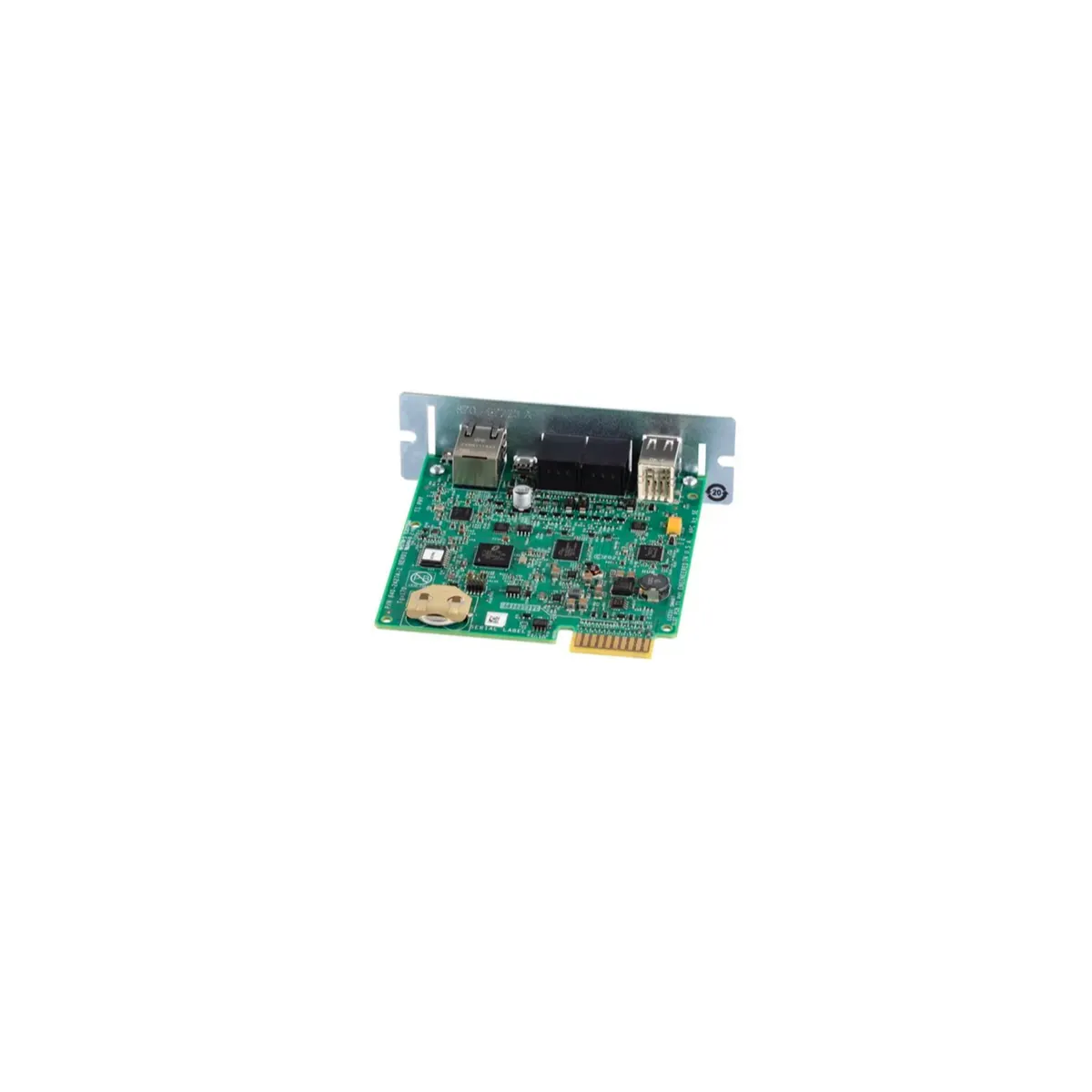
Why choose the environmental-monitoring variant?
The APC AP9641 adds supported network management and environmental input capability to compatible UPS equipment. It is worth evaluating when a network closet needs both UPS information and a small set of supported environmental measurements in the same management workflow. A temperature alarm can be useful context when troubleshooting an overheating closet, while UPS events explain a different part of the incident. Bringing those signals together can make response easier if someone owns the alerts.
The AP9641 is not a complete room-monitoring system by itself, and environmental monitoring does not make it compatible with every UPS or every sensor. The complete bill of materials matters: UPS, card, probes, network access, firmware and management software. This review evaluates current manufacturer documentation. We have not installed a card, measured sensor accuracy or tested an alarm delivery path, so the recommendations are about fit and purchasing decisions rather than measured performance.
Confirm the exact UPS first
Schneider Electric’s NMC compatibility chart places AP9641 with AP9640 and AP9643 for specified UPS families. Supported Smart-UPS prefixes include SMT, SMX and SRT, but the chart also contains conditions for older equipment and different application files. Its SUA note requires manufacture after 2008 with UPS firmware v1.4.2 or greater. A SmartSlot opening or the word APC on the cabinet therefore does not establish universal compatibility.
Record the UPS's full model and serial label before ordering. A rack using an SMT1500RM2UC should be checked against its exact accessory information and the SMT entry, rather than a seller's generic Smart-UPS statement. For a larger or different supported platform, verify the appropriate card application and any embedded management-card requirements. A correct physical fit is only the first step; successful UPS communication and the required management features must also be established.
Understand the sensor interfaces
The manufacturer's environmental accessory table lists two universal I/O ports for AP9641 and compatible accessories including AP9335T, AP9335TH and AP9810. The table also lists other supported devices with firmware conditions. Use that exact matrix to build the sensor list. Do not treat an RJ45-style connector as permission to attach an Ethernet device, a generic probe or an accessory from a different manufacturer's system.
| Requirement | Candidate to verify | Buying implication |
|---|---|---|
| Temperature only | AP9335T in the official compatibility table | Confirm quantity and whether the listing includes a probe |
| Temperature and humidity | AP9335TH in the official table | A temperature-only bundle does not establish humidity measurement |
| Supported dry contacts | AP9810 accessory | Check the actual input/output requirement and wiring documentation |
| No external sensors | AP9640 alternative | May avoid unused environmental interfaces |
| Leak or other specialist sensing | Exact device and firmware in the current matrix | Do not infer support from the connector shape |
Check the package contents instead of assuming a sensor is supplied because a photograph shows one. A bundle may include a temperature probe while a bare-card listing does not. Humidity capability needs the appropriate sensor, not a software checkbox alone. For an installation with several measurement locations, count ports and the exact supported topology before purchasing multiple accessories. Avoid building a plan around an unverified splitter or extension cable.
A useful measurement needs a useful location
A single sensor reports conditions where it is installed. It does not establish the temperature of every server inlet or every shelf in a cabinet. Decide which operational question each probe should answer. A sensor intended to detect warm intake air should not be placed solely where the cable is easiest to hide. A probe beside exhaust airflow answers a different question. Document placement so later changes can be interpreted correctly.
Set thresholds in the context of the equipment and the site's environmental policy. A number copied from an unrelated rack can generate nuisance alarms or miss a relevant problem. Include a clear response owner and an escalation route. An alert is useful only if someone can distinguish an immediate cooling issue from an expected maintenance condition. The AP9641's sensor support provides an input to that process; it does not supply the operating policy or guarantee that a message will be delivered.
Firmware and subscription ownership
The current AP9641 product page advertises a one-year Secure NMC System subscription. The manufacturer’s NMC offering explains its firmware maintenance system. Include that entitlement and the ongoing update process in the procurement record. Hardware ownership, a firmware subscription and optional broader monitoring services should be identified separately so the team understands what is included and what may need renewal.
This matters particularly for open-box or used stock. A seller's statement that a card works does not establish that an entitlement remains available, transfers to the buyer or matches the required platform. Request clarification before placing an order. Do not base a new deployment on staying indefinitely with an old firmware release to avoid maintenance. Check current release notes and security information when commissioning, and assign the update task to a named owner.
Plan the UPS and environmental response together
UPS events and high temperature can require different actions. A utility outage may start a controlled shutdown sequence, while a warm closet may call for a cooling investigation or a reduction in nonessential load. Write those procedures separately and identify any shared dependencies. Avoid making a sensor alert directly trigger an unreviewed outlet or shutdown action simply because the interface offers automation options.
Network access also needs a power plan. The switches and routers carrying the management traffic must remain reachable for the desired monitoring period. Map their feeds and startup behavior along with the UPS. If notification depends on an external service, document that dependency too. The presence of an Ethernet management card does not create a second communications path or establish that alerts survive a broader site failure.
When AP9641 is more than the project needs
If the site already has a suitable independent environmental system, AP9640 may be the more direct functional comparison. The decision should account for duplicated probes and alert destinations rather than assuming more ports are always better. On the other hand, if supported temperature and humidity inputs are part of the intended design, evaluate AP9641 with those exact accessories from the start.
A large room requiring many sensor points, cameras or specialist monitoring may need a different system architecture. Two universal inputs should not be stretched into a room-wide coverage claim. Likewise, a card installed in one UPS does not measure each connected server's power draw or turn ordinary PDU receptacles into individually switched outlets. Keep environmental sensing, UPS management and PDU control as explicit requirements even when they are presented in one dashboard.
Before placing an order
- Verify the exact UPS, supported application and firmware conditions.
- List each desired measurement and its compatible sensor part number.
- Confirm what the actual seller package includes.
- Check sensor cable routing, mounting and the supported topology.
- Confirm the included update entitlement and its activation process.
- Define alert ownership and validate the management and notification path.
After installation, a controlled acceptance check should confirm recognition of the UPS and each sensor, realistic readings, suitable timestamps and delivery of a harmless test notification where the software supports it. Record the result and configuration. Those are suggested checks for the purchaser, not tests we have performed. If the listing cannot establish exact model identity or the manufacturer cannot confirm compatibility, resolve the uncertainty before deployment.
Verdict
AP9641 is the NMC3 option to examine when a supported UPS should also collect compatible environmental inputs. Its strongest buying case is a clearly defined small sensor plan with an owner for the resulting alerts. The crucial conditions remain exact UPS support, the right probes and maintained firmware. Satisfying those conditions matters more than a broad promise that a network card makes a rack smart.
Check the exact models
Confirm the model suffix, electrical configuration, seller, condition, included hardware and warranty. These are Amazon.com model searches; results can include alternatives.
Sources and research basis
- Schneider Electric US AP9641 product pagePrimary documentation · checked 15 October 2026
- UPS NMC compatibility chartPrimary documentation · checked 15 October 2026
- NMC environmental accessory compatibilityPrimary documentation · checked 15 October 2026
- Secure NMC SystemPrimary documentation · checked 15 October 2026
Manufacturer specifications describe the documented configuration. Buying recommendations are our interpretation of those features. No original runtime, acoustic, efficiency, switching or software test is claimed. Report a correction.