What should drive the choice?
Shortlist it when external-battery runtime and rack/tower flexibility are requirements. The base model is line-interactive and should not be specified as an online UPS or an NC network-card bundle.
Research based on linked manufacturer documentation. We have not physically tested this equipment.
The reason to choose Smart-UPS X
The APC SMX1500RM2UC is worth investigating when a small rack needs more battery time than an internal-battery model can provide at the required load. Its defining buying feature is the documented external-battery option. That makes it a different proposition from selecting a UPS only because its rated wattage is higher. A project may need more minutes without needing a much larger inverter.
This review covers the exact US 120 V C model, using manufacturer specifications. We have not installed battery packs or tested discharge behavior. Our evaluation separates the supported configuration from the results a completed installation must verify. The central question is whether the external-battery architecture, total footprint and management path solve your actual outage requirement.
Capacity, topology and connections
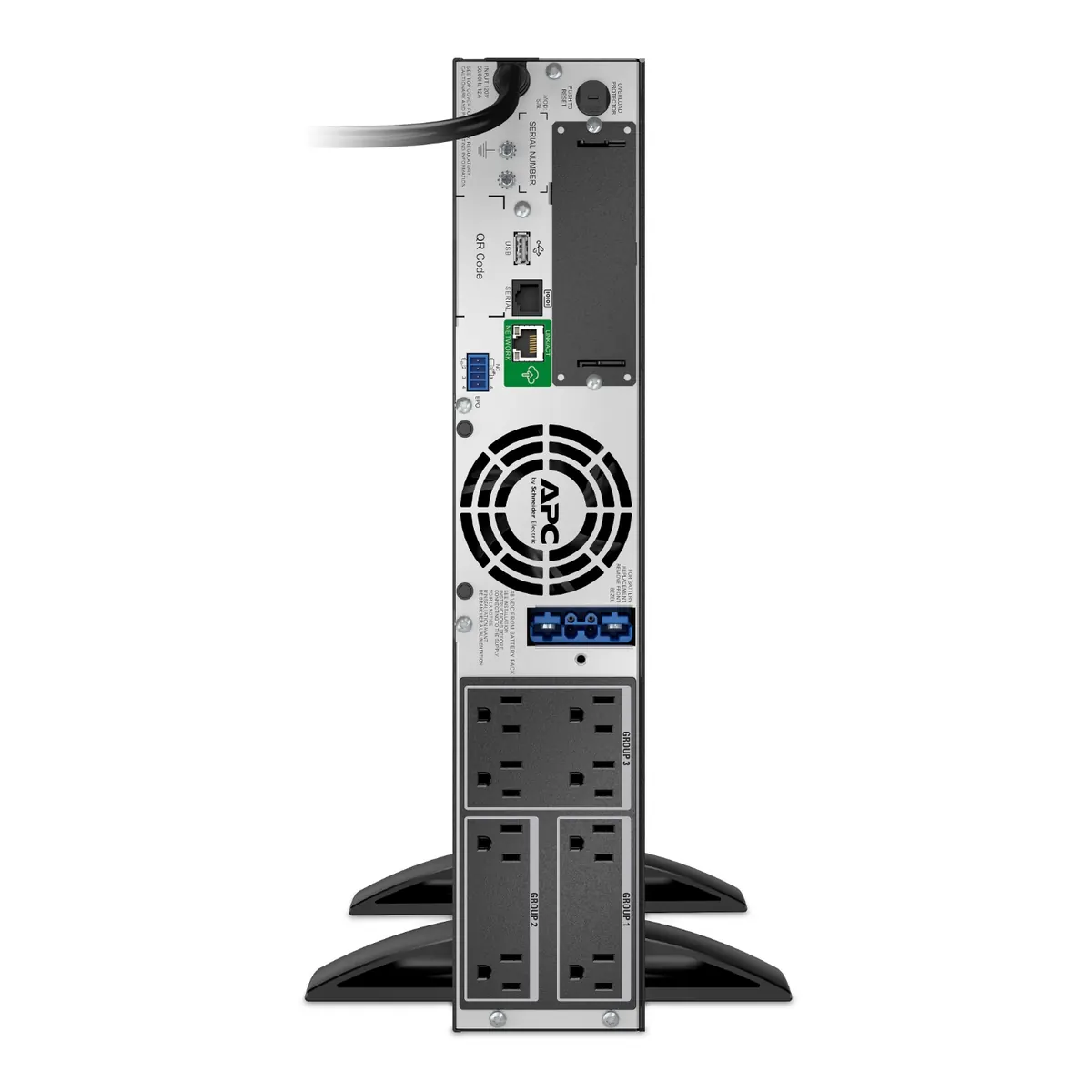
The official US page identifies 1,440 VA and 1,350 W, a 120 V line-interactive sine-wave design, 2U rack/tower format and eight NEMA 5-15R outlets. The exact-model datasheet specifies a NEMA 5-15P input. Treat both output limits as requirements, rather than translating the 1500 family label into 1,500 W.
For an illustrative 900 W equipment load, the watt rating is 450 W above the measured requirement. That is an arithmetic capacity comparison only. It says nothing about whether the internal battery can keep the equipment running for twenty minutes, whether the site supply is appropriate, or whether startup conditions remain acceptable. Those require their own evidence.
Line-interactive is also a meaningful boundary. Extended runtime does not make this an online double-conversion UPS. If a project specification calls for that topology, compare appropriate online models rather than substituting SMX because it accepts battery packs. Power conversion behavior and stored-energy capacity answer different design questions.
External batteries change more than the runtime chart
Schneider's current product page states that up to five SMX48RMBP2U external battery packs can be added. Verify the current compatibility and installation instructions for the delivered unit before ordering. A compatible pack is not interchangeable with an arbitrary battery enclosure that happens to use a similar voltage. The correct part number belongs in both the purchase order and the service record.
Build a runtime requirement before choosing the number of packs. Start with the equipment load in watts and the intended purpose: orderly shutdown, bridging a short interruption, or supporting a longer event. Use the manufacturer's curve for that exact load and battery configuration. Do not multiply internal-battery minutes by the pack count. Battery systems do not justify that simple scaling assumption.
The full configuration needs cabinet space, supported mounting, cable clearance and an approved handling plan. It also creates a larger future battery-service task. Include replacement timing, spare availability and service access in the operating plan. Buying one extra pack because it feels reassuring may be less useful than documenting a target duration and checking the complete installed configuration against it.
Recharge behavior matters after a real outage. A system selected only for the first event may be poorly understood when another event occurs before the batteries recover. Ask the manufacturer for configuration-specific charging information and use it in the recovery procedure. We have not tested recharge times for a multi-pack arrangement, so this review does not assign a recovery-performance score.
A written battery inventory also helps at service time. Label each enclosure with the supported system and keep the replacement specification with the site's equipment records. That allows a future technician to distinguish a runtime expansion from replacement of the internal cartridge, instead of ordering by the appearance of an enclosure or an abbreviated invoice description.
Rack/tower flexibility and the delivered bundle
The manufacturer describes rack/tower conversion and lists a rail kit in its product overview. Check the exact seller package, particularly for used or open-box units. Rack hardware, tower supports and all required battery connectors should be enumerated. A seller photo showing a complete new configuration does not establish the accessories supplied with the specific item being sold.
For a rack installation, measure usable depth and rear cable space using the current drawing. For a tower installation, establish stable placement and service access using the approved instructions. In either case, protect the route used to remove batteries later. A densely packed rack can satisfy its initial equipment count while making future maintenance unnecessarily disruptive.
Compare the complete footprint with a larger internal-battery alternative. The base UPS takes 2U, but a configuration with additional battery enclosures consumes more than that. A quote described simply as a 2U backup solution may therefore omit the very accessories that create the required runtime. Require the installed layout, not just the base chassis height.
Do not confuse C with NC
SmartConnect monitoring is part of the official description. That does not make the SMX1500RM2UC identical to an SMX1500RM2UCNC bundle. Confirm whether a network management card is supplied and which shutdown functions require optional hardware or software. A suffix that appears minor in a search result can be a material difference in the delivered management configuration.
Define the required communication outcomes before selecting accessories. A local USB-connected host, several physical servers and a virtualized cluster are different integration tasks. Check the current software support matrix, licensing and network dependencies. Keep the relevant switch and storage infrastructure in the protected-load inventory so that a command can still reach its destination during a power event.
An extended-runtime configuration also needs sensible thresholds. A longer battery window can be useful, but it should not cause the organization to postpone shutdown beyond a safe remaining reserve. Decide who can change settings and document why they were selected. During commissioning, validate the actual workflow under approved site procedures rather than treating a successful dashboard login as proof of outage readiness.
How to compare the complete purchase
Against the SMT1500RM2UC, the SMX model's published 1,350 W rating is 350 W higher than the SMT model's 1,000 W. More significantly for some buyers, the SMX has an external-battery path. Against the CyberPower PR1500RT2UC, it has a lower watt rating but a different runtime-expansion proposition. Neither comparison establishes reliability or matched-load runtime superiority.
Use a quote worksheet with the base UPS, required battery packs, management components, mounting hardware and service coverage on separate lines. Then compare the configurations that actually meet the same requirement. If one quote is for internal batteries and another includes external packs, their purchase prices answer different questions. Exact model and accessory matching prevents a misleading bargain from surviving procurement review.
Our conclusion is to choose SMX1500RM2UC for a documented need for runtime expansion within its capacity and topology limits. Skip it when no external-battery requirement exists and a simpler model already meets the task, or when online double conversion is mandatory. The most defensible order is one that names the full configuration and has a measurable acceptance procedure for the outage behavior it was bought to provide.
Check the exact models
Confirm the model suffix, electrical configuration, seller, condition, included hardware and warranty. These are Amazon.com model searches; results can include alternatives.
Sources and research basis
- Schneider Electric SMX1500RM2UC US pagePrimary documentation · checked 15 October 2026
- Schneider Electric SMX1500RM2UC exact-model datasheetPrimary documentation · checked 15 October 2026
Manufacturer specifications describe the documented configuration. Buying recommendations are our interpretation of those features. No original runtime, acoustic, efficiency, switching or software test is claimed. Report a correction.