What should drive the choice?
Choose PR1500RT2UC for a supported base-battery task that benefits from its 1,500 W limit. Choose SMX1500RM2UC when the 1,350 W limit fits and its documented external-battery architecture solves the runtime requirement.
Research based on linked manufacturer documentation. We have not physically tested this equipment.
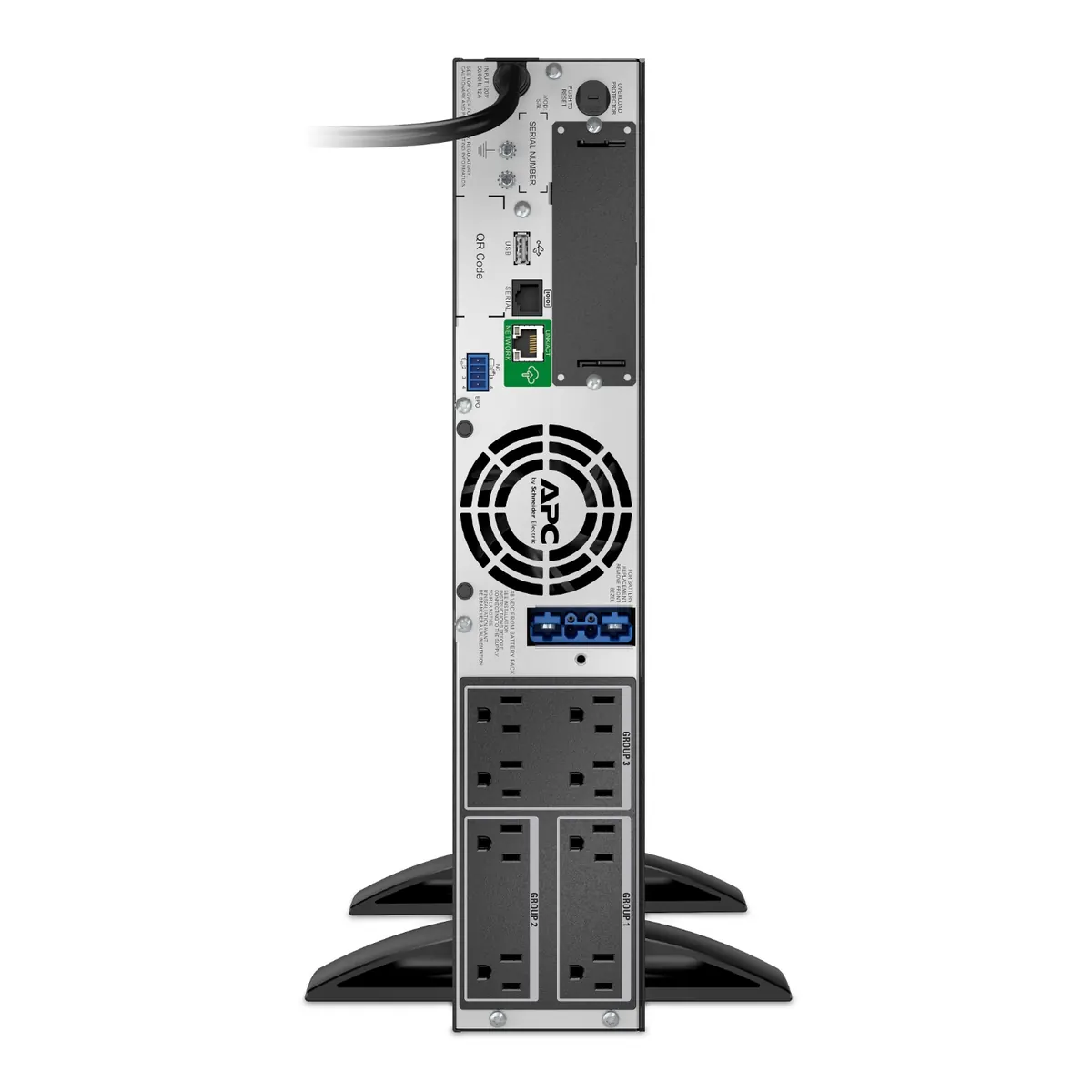
Separate a higher watt ceiling from a longer battery configuration
The APC SMX1500RM2UC and CyberPower PR1500RT2UC look close in a broad 1500 rack UPS search, but their strongest buying arguments differ. CyberPower publishes the higher output capacity for the base unit. APC documents an external-battery option for this exact SMX model. Decide whether the project needs more supported watts, more battery time or both before treating the products as equivalent quotations.
This is a manufacturer-source comparison of the complete US model numbers. We have not tested battery endurance, acoustic behavior, efficiency or reliability. The analysis uses documented specifications to show which configuration belongs in a shortlist and which acceptance questions remain. Full suffix matching matters because a network-card bundle or an XL model can change the delivered package and supported battery arrangement.
The same family number conceals two output limits
Schneider's SMX1500RM2UC listing specifies 1,440 VA and 1,350 W. CyberPower's PR1500RT2UC page specifies 1,500 VA and 1,500 W. Both are nominal 120 V, line-interactive sine-wave products in 2U rack/tower format. The PR adds 150 W of published real-power capacity and 60 VA of apparent-power capacity.
| Purchase distinction | APC SMX1500RM2UC | CyberPower PR1500RT2UC |
|---|---|---|
| Published output | 1,440 VA / 1,350 W | 1,500 VA / 1,500 W |
| Input plug | NEMA 5-15P | NEMA 5-15P |
| Outputs | Eight NEMA 5-15R | Eight NEMA 5-15R |
| Battery comparison | Documented SMX48RMBP2U expansion | Assess this exact base-battery configuration |
| Network management | Optional card through SmartSlot | Optional RMCARD205 |
An illustrative 1,400 W rack exceeds the SMX watt limit and sits 100 W below the PR limit, assuming its VA also fits. That is a real capacity distinction. At 900 W, both watt ceilings contain the load, making runtime and management more useful differentiators. Neither example is a recommended operating margin, a measurement of a real rack or evidence of the batteries' duration.
Capture important load states rather than only idle consumption. Storage work, backup jobs and loss of another source can change what this UPS must support. Where redundant equipment is involved, write down the intended failure condition and measure or establish that demand. The purchasing record should make clear whether the selection supports ordinary shared operation or the required load after a source is lost.
SMX expansion is a model-specific capability
Schneider explicitly allows up to five SMX48RMBP2U battery packs with SMX1500RM2UC. That gives this exact model a documented way to build a longer-runtime configuration within its output limits. Select the number of packs from the required duration and manufacturer runtime data, not from a general preference for more batteries. Record the complete configuration on the quote request.
Do not assign a CyberPower RTXL model's battery capability to PR1500RT2UC. The official BP48VP2U02 compatibility page names PR1500RTXL2UC and other specific XL models; it does not list PR1500RT2UC. A proposal needing CyberPower expansion should compare the exact supported XL configuration separately. Similar model names and shared battery-cartridge families do not establish external-module compatibility.
Battery expansion also changes the installed system. Include enclosure space, supported mounting, DC connections, service access and future battery replacements. The base SMX chassis takes 2U, while the required battery packs add their own footprint. A complete runtime quote should show that footprint and all accessories. Otherwise a compact base-UPS description can hide the space needed to meet the actual requirement.
Compare the same watts and the same outage objective
The SMX datasheet lists base-battery references of fifteen minutes at half load and five minutes at full load. CyberPower lists 18.2 and 6.5 minutes respectively. Those percentages represent 675 W and 1,350 W for SMX, versus 750 W and 1,500 W for PR. The columns therefore do not establish a matched-load runtime winner. We have no independent measurements that settle that question.
Use both exact-model runtime resources at the rack's measured demand, with the intended batteries. Keep the manufacturer conditions and qualifications visible. New-battery planning references cannot guarantee the same result from an older unit in a warm equipment room. For an expanded SMX configuration, use the supported pack count's data rather than multiplying the base minutes by the number of enclosures.
The outage objective should say what the equipment must accomplish. A storage-and-host shutdown sequence needs timed application stops, completed writes and powered network communication. A continuity objective needs an explicit operating duration and a fallback point. Give each outcome an acceptance step under approved site procedures, so the final comparison has more substance than a collection of runtime claims.
Compare the actual card and software package
APC advertises SmartConnect cloud monitoring and a SmartSlot for an optional network management card. CyberPower advertises built-in cloud monitoring and optional RMCARD205. Both provide communication choices that need to be matched to the actual operating environment. Include required hardware, software and current service terms on the quote rather than assuming a cloud connection completes coordinated shutdown.
For a single local server, verify the supported USB or serial arrangement and current software compatibility. For multiple hosts, define how commands reach each host and how storage and virtualization dependencies are handled. A management card's presence is only part of that design. The team must also know which switch stays powered, which service stops first and who maintains the configuration.
Exact suffixes prevent an unfair bundle comparison. An APC NC package and a CyberPower CN package should be compared through their delivered contents, while this article concerns the specified base models. Ask for the card model and all required licenses or service features explicitly. Establish alert ownership and behavior when internet connectivity is lost before the system is accepted.
Shared connectors simplify only part of installation
Both exact models specify 5-15P inputs and eight 5-15R outputs, but the site supply still needs to satisfy the manufacturer instructions. Prepare an outlet map using actual plug types and cord count. Eight outlets do not create independent power sources. If redundant supplies are intended to provide A/B resilience, show both sources and their failure-state loading separately.
Check each chassis's current dimensions, mounting instructions and rear cable clearance against the actual rack. Confirm rails, brackets, tower supports and supplied cables with the seller. A common 2U label establishes height, not complete fit or interchangeable mounting hardware. For an SMX with packs, extend the same check to every enclosure and preserve access for future battery work.
Choose the documented configuration that completes the task
PR1500RT2UC is the stronger capacity candidate when the load needs more than 1,350 W but fits its own limits and its base-battery runtime supports the job. SMX1500RM2UC is the more direct candidate when its capacity fits and a documented external-battery configuration is required. Neither is online double conversion; a requirement for that topology needs a different shortlist.
For example, consider a proposed 850 W installation with a required twenty-minute continuity window. Both watt limits contain that demand, but neither capacity figure proves the duration. Request the exact runtime evidence for each offered configuration and identify the fallback shutdown point. If the APC proposal adds packs, include their installed space and future battery work. If the CyberPower proposal substitutes an XL model, update the complete model number and review its specification independently. This prevents an apparently small quotation change from carrying unsupported assumptions into the equipment order.
Compare complete ownership configurations: batteries, management components, mounting parts, seller contents and service arrangements. A used unit needs documented battery history rather than an assumption of new-battery runtime. Consult the individual SMX1500RM2UC review and PR1500RT2UC review for model-specific purchasing checks, then make the order match the capacity, duration and shutdown procedure the site can verify.
Check the exact models
Confirm the model suffix, electrical configuration, seller, condition, included hardware and warranty. These are Amazon.com model searches; results can include alternatives.
Sources and research basis
- Schneider Electric SMX1500RM2UC US product pagePrimary documentation · checked 15 October 2026
- Schneider Electric SMX1500RM2UC detailed US listingPrimary documentation · checked 15 October 2026
- Schneider Electric SMX1500RM2UC exact datasheetPrimary documentation · checked 15 October 2026
- CyberPower PR1500RT2UC official US product pagePrimary documentation · checked 15 October 2026
- CyberPower BP48VP2U02 exact compatibility listPrimary documentation · checked 15 October 2026
Manufacturer specifications describe the documented configuration. Buying recommendations are our interpretation of those features. No original runtime, acoustic, efficiency, switching or software test is claimed. Report a correction.