What should drive the choice?
Choose PDUMH15NET2LX for a compatible 120V rack that needs deliberate individual outlet control. Treat automatic recovery as a separate configuration project.
Research based on linked manufacturer documentation. We have not physically tested this equipment.
Buy it for a defined recovery action
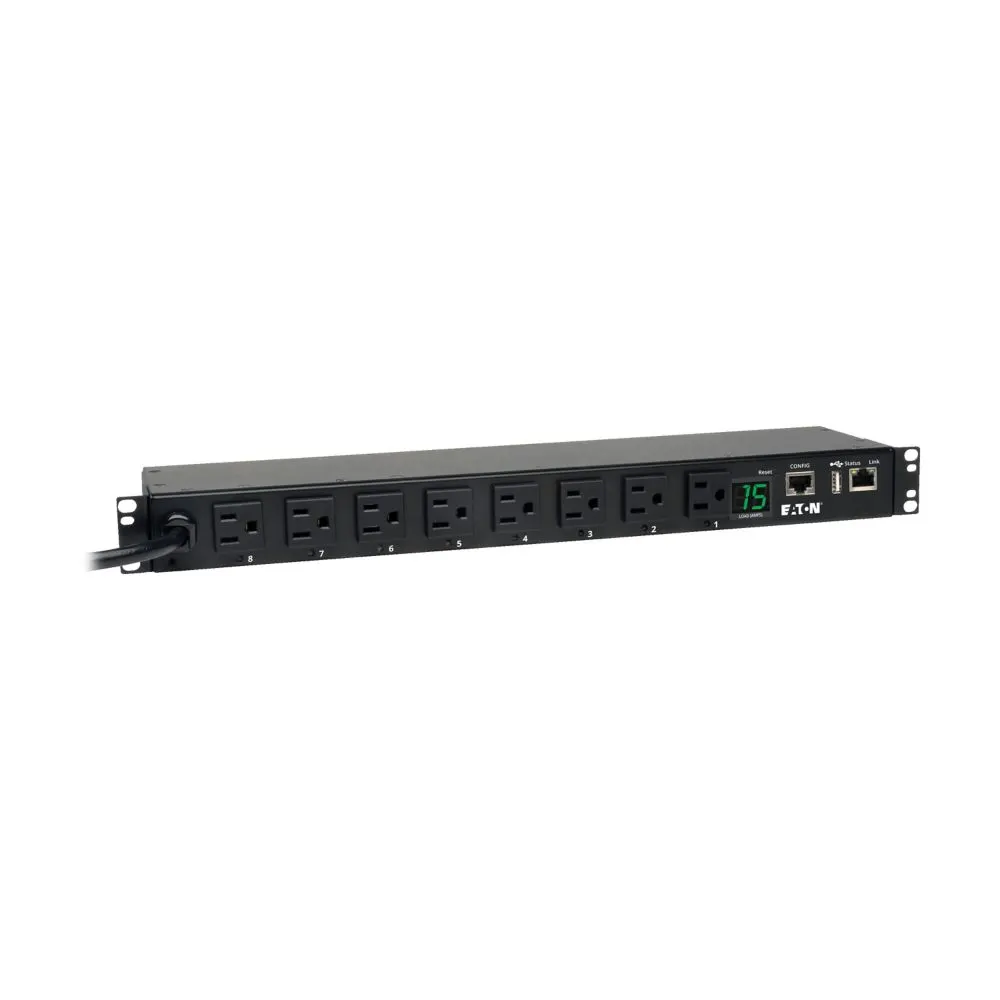
The Eaton PDUMH15NET2LX is a useful candidate for a small rack where an administrator must control individual equipment power remotely. Its eight switched receptacles can support an approved appliance restart, a maintenance shutdown or disabling an unused outlet. That capability is valuable when the team knows exactly which cord serves the affected device and which power action is appropriate. It has less value if the rack only needs additional sockets.
The project should begin with the recovery procedure and then select the hardware that can execute it. A router, a storage array and a hypervisor have different requirements before power is removed. This review examines Eaton's current documents and the buying implications. We have not operated a sample, tested a reboot sequence or measured the management interface's response time.
Twelve amps continuous is the relevant planning figure
The current product specification lists eight individually switched NEMA 5-15R outlets, NEMA 5-15P input and a 12ft attached cable. It identifies 120V nominal output and agency derating to 12A continuous, with 1.44kW at 120V in its capacity field. Do not turn the recommended 15A service class into a 15A continuous operating target. The upstream source and actual installation can impose additional limits.
| Purchase detail | Documented PDUMH15NET2LX configuration | Decision it informs |
|---|---|---|
| Distribution | Eight individually switched 5-15R outlets | Count supplies and define power actions |
| Input | 5-15P; 12ft cord | Match the source and routed distance |
| Continuous figure | 12A agency derated | Plan the aggregate load accordingly |
| Management | Pre-installed WEBCARDLX with PADM20 | Verify the actual delivered configuration |
| Physical fit | 1U; 4.25in chassis depth; 7.3in minimum rack depth listed | Allow installed clearance |
| Measurement | Total PDU current in amps | Individual control does not imply individual metering |
Each connected power supply consumes a receptacle, even when two supplies belong to one chassis. Assign outlets before purchase and leave any required reserve explicit. A spare socket is a physical convenience, while electrical headroom depends on the load plan. With dual-supply equipment, document the upstream paths as well as the local labels so the service procedure does not accidentally remove both feeds.
Check the complete LX identity
The current product sheet identifies pre-installed WEBCARDLX and PowerAlert Device Manager, called PADM20. Confirm the complete PDUMH15NET2LX identifier in the quotation. A broadly worded PDUMH15NET listing or an older SNMPWEBCARD screenshot does not establish that the offered hardware is this LX configuration. Ask for the actual card and firmware information when buying used or open-box stock.
Match the commissioning instructions to that platform. Older SNMPWEBCARD manuals for related equipment should not be treated as the configuration guide for WEBCARDLX. Keep the installed revision, relevant release information and a configuration record with the rack documentation. A familiar web page or a successful ping does not prove that the required monitoring, authentication and recovery integrations are ready.
Start with deliberate control
Before enabling an automated action, establish a reliable manual one. Give each outlet a name that identifies the asset and supply, then check the map physically during commissioning. Describe when the device may be restarted and who can authorize it. A remote interface cannot determine whether an application has finished writing or whether another administrator is performing a sensitive maintenance operation.
For a dual-supply chassis, decide whether cycling one receptacle will accomplish the intended outcome. It may leave the equipment running from its other source. That can be useful during a power-supply check, but it may not recover a locked device. Conversely, cycling both feeds removes its power entirely. The procedure needs to explain the intended result rather than using the word reboot without identifying the cords involved.
Auto Probe needs a failure definition
Eaton advertises IP-based Auto Probe on the current platform, and its Auto Probe guide explains the recovery offering. The important design choice is what an unsuccessful probe actually means at this site. Lost reachability can indicate an appliance problem, but it can also reflect a network path, an address change or planned maintenance. A power command based on the wrong interpretation can add another incident.
Select the monitored target and recovery condition deliberately, then follow the supported configuration documentation. Consider how an administrator will suspend the process for maintenance and how repeated recovery attempts will be investigated. Validate the behavior under controlled conditions before depending on it. This is a configuration responsibility around the product, not a claim that its default settings are suitable for every router or every network topology.
Power recovery depends on a network path
Draw the management connection from the administrator to the PDU. Include the switches, router and external connection carrying it. If the target device provides that path, removing its power may interrupt the session used to observe the outcome. Verify the supported action and restoration behavior for the actual configuration. An Ethernet PDU does not create independent out-of-band access merely by having a network port.
Also check startup dependencies. A switch may need time before another appliance can contact a controller, and storage may need to be available before an application starts. A sequence should be based on the equipment's documented requirements and a controlled acceptance exercise. A list of energized outlets is not the same thing as a restored service. Record the service-level checks that show the recovery achieved its purpose.
Keep measurement requirements separate
The documented current display reports total PDU load. Individual switching identifies where a command can be sent, while metering granularity identifies what can be measured. Do not infer per-outlet energy, per-server kilowatt-hours or a billing ledger from eight independently controllable sockets. Obtain explicit support if those measurements are part of the purchasing brief.
Aggregate current can still be useful for capacity observation. Record a reading in the context of the workload and planned change. A value collected during an idle period may not represent the condition that matters for headroom. If the rack uses separate feeds, evaluate the expected demand on the surviving path under the relevant failure condition. The PDU's information is evidence for that review, not a substitute for the complete power design.
Measure the installed space
The product page lists a 4.25in chassis depth and a 7.3in minimum rack depth. The difference is a useful reminder that plugs and cables occupy space beyond the body. Check the retention arrangement, cable bends, local indicators and access to the network interface. In a small cabinet, mounting orientation can determine whether a technician can identify a cord without disturbing neighboring equipment.
Measure the twelve-foot input cable along its intended route, including vertical travel and appropriate slack. Confirm that supplied mounting parts meet the intended configuration. Some numeric fields in the downloadable sheet contain zero placeholders for dimensions, so use the populated product-page measurements and the actual drawing for a close fit. A placeholder is not evidence that clearance can be ignored.
Make commissioning observable
Use an approved acceptance plan to verify model identity, load communication, timestamps, outlet labels, access rights and a harmless test notification where supported. Validate an agreed outlet action on suitable noncritical equipment before the rack depends on it. Maintain configuration backups and review current firmware information through the PADM20 documentation and manufacturer support process.
If the site only needs observation, the PDUMNH15 is a monitored alternative. If local observation is sufficient, examine a local metered unit instead. A switched product introduces useful authority and additional operating work, so its selection should be tied to the recovery requirement rather than a preference for the largest feature list.
Verdict
PDUMH15NET2LX is a sensible shortlist choice when a compatible rack needs individual remote power actions and an administrator owns the workflow. Verify the exact LX configuration, twelve-amp continuous plan and installed clearance. Use Auto Probe only after defining and validating the failure condition it is meant to address.
Check the exact models
Confirm the model suffix, electrical configuration, seller, condition, included hardware and warranty. These are Amazon.com model searches; results can include alternatives.
Sources and research basis
- Eaton PDUMH15NET2LX current specificationsPrimary documentation · checked 15 October 2026
- Eaton PDUMH15NET2LX product sheetPrimary documentation · checked 15 October 2026
- Eaton Auto Probe solution guidePrimary documentation · checked 15 October 2026
- PowerAlert Device Manager 20 command-line user guidePrimary documentation · checked 15 October 2026
Manufacturer specifications describe the documented configuration. Buying recommendations are our interpretation of those features. No original runtime, acoustic, efficiency, switching or software test is claimed. Report a correction.