What should drive the choice?
Consider PDUMH20 for local metering and twelve connections, but resolve the published 16A versus 20A capacity information before a load plan depends on the difference.
Research based on linked manufacturer documentation. We have not physically tested this equipment.
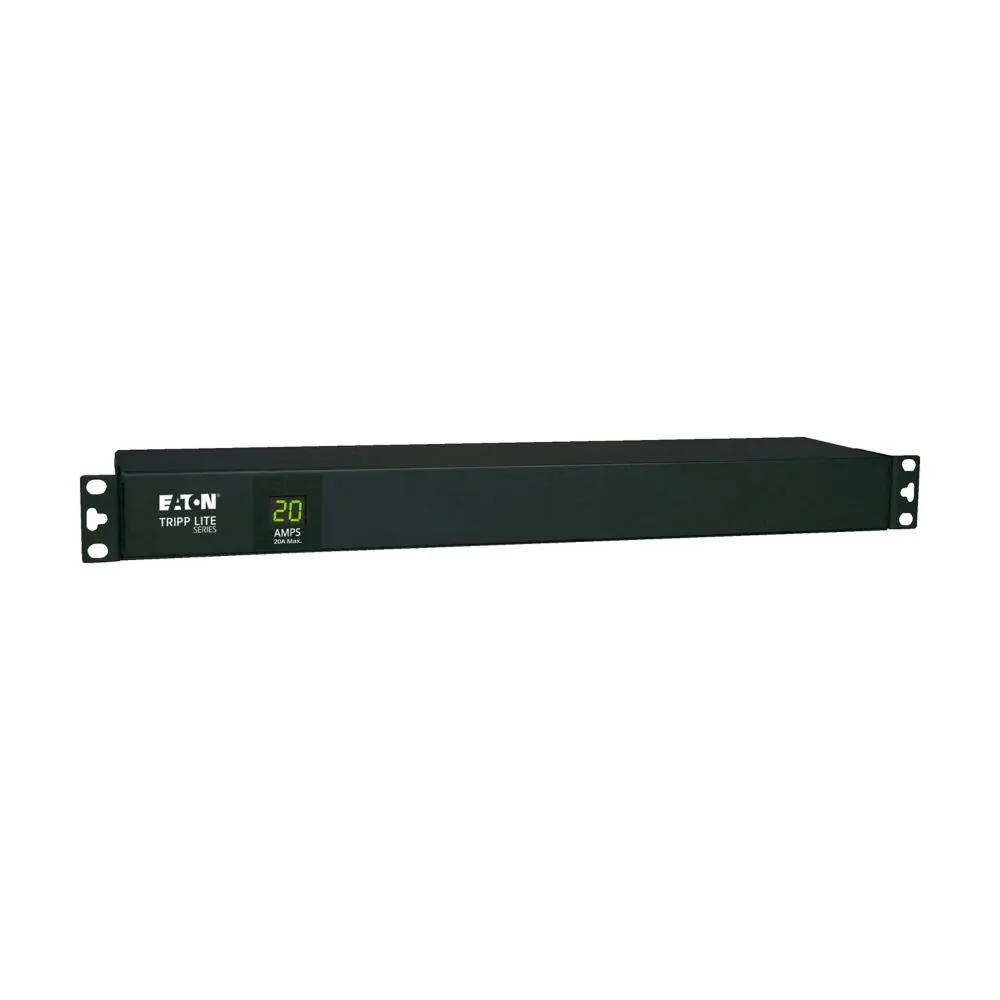
A useful layout with a capacity detail to settle
The Eaton PDUMH20 is a candidate for a rack that needs twelve compatible receptacles and a local current display. Its appeal is straightforward: a technician can observe aggregate amperage without adding network management, while a relatively generous outlet count accommodates several small appliances. The buying decision has one material complication. Eaton's current published capacity fields do not present a single unambiguous continuous-current statement for this model.
Resolve that detail before treating the larger headline as available persistent load. The appropriate source, load plan and exact supplied revision still need to be established. This article reviews manufacturer information and practical installation choices. We have not measured a unit, tested its breaker, checked meter accuracy or verified a particular seller's hardware.
The 16A and 20A fields need explicit attention
The current product page lists 16A in its amperage-rating field and 20A in its maximum-current field. Its capacity detail also says 2.4kW at 120V and 20A total, with 16A maximum per outlet. The current product sheet repeats the 2.4kW and 20A total-capacity description. Those facts should not be flattened into a claim that this review has established permission for a 20A continuous rack load.
Use the published 16A rating as a conservative planning gate while asking Eaton to clarify the exact unit and intended installation. If the project depends on the difference, obtain a written explanation of continuous and maximum limits before ordering. An answer for another PDUMH20 suffix is insufficient. Nor does arithmetic from 120V times 20A resolve the operating conditions behind a manufacturer rating. Keep the original source fields in the procurement record so the question remains specific.
| Selection point | Published PDUMH20 information | Action before purchase |
|---|---|---|
| Current fields | 16A rating; 20A maximum and total-capacity fields | Clarify continuous operation for the exact unit |
| Outputs | Twelve NEMA 5-15/20R receptacles | Check cords and plug clearance |
| Input arrangement | L5-20P attached cord; supplied 5-20P adapter | Match the intended compatible source |
| Cable length | 15ft | Measure the actual route |
| Observation | Local aggregate current display | Define who will read and record it |
| Fit | 4.5in depth; 9.5in minimum rack depth listed | Include connected cables and service space |
The supplied adapter is part of the specified package
Eaton describes an attached NEMA L5-20P input and an included L5-20R to 5-20P adapter. Verify which supported arrangement the site intends to use and whether the actual seller package includes that part. This is a manufacturer-described accessory for this product; it should not be confused with permission to improvise an arbitrary adapter chain or change the source's electrical capacity.
Inspect the source receptacle and trace the upstream path before choosing the connection arrangement. If a UPS is involved, check its relevant output and instructions as well as the PDU's. A compatible connector does not by itself show that the source has sufficient available capacity for the planned equipment. Include the selected arrangement in the rack record so a later technician does not have to reconstruct it from plug shapes.
Twelve connections can solve a density problem
A network cabinet can contain many modest loads: a firewall, several switches, console equipment and appliances with external supplies. In that setting, receptacle count can become a constraint before aggregate demand does. Inventory every cord and leave known future additions explicit. A hypothetical twelve-cord plan fits the nominal count, but it leaves no physical reserve for another permanent connection.
Count each redundant supply individually. If the rack has A and B distributions, make a separate inventory for each rather than counting two cords as one device. Map their upstream sources too. A second strip provides connection flexibility, while independent operation depends on the complete paths. A change that fills a convenient spare socket can quietly alter that arrangement unless labels and records are maintained.
What the local display contributes
The digital meter reports total output current in amps. That can make an approved equipment change easier to assess during a service visit. Record the reading with the workload, date and measurement boundary so it can be interpreted later. An idle reading and a reading during a demanding operating period answer different questions, even when both are accurate observations.
Decide what a technician should do with an unexpected result. The useful process is to compare with the rack's documented capacity and investigate the equipment state, not to wait for a protective device to operate. A two-digit display can support that process without providing a historical record itself. If nobody visits or records observations, the extra visibility may not solve the team's actual information problem.
It remains a local metered product
PDUMH20 should not be confused with PDUMNH20 or PDUMH20NET2LX. The additional letters identify different management functions in this family. The local display does not establish a web interface, remote notification path or a command to cycle an individual outlet. Use the exact identifier in the purchase request so a seller cannot substitute a different tier based only on voltage and socket count.
For remote observation, examine the PDUMNH20. For individual power commands, examine the PDUMH20NET2LX. Those alternatives have their own capacity and outlet arrangements. Do not copy the local model's twelve-output count into either network model or assume that adding a management card later will create switching hardware that the selected product does not have.
Check the nine-and-a-half-inch installation requirement
Eaton lists a 4.5in chassis depth and a 9.5in minimum required rack depth. The larger figure deserves attention in a shallow cabinet. Plugs, bends and access occupy space beyond the enclosure. Plan the mounting direction with the equipment's inlet locations and the technician's service route in mind. A rack unit that bolts in can still be difficult to maintain if every cord crosses another component.
The current documents also contain inconsistent dimensional presentation between some inch and centimeter entries. For a close fit, obtain the current mechanical drawing or a manufacturer-confirmed installed envelope for the exact stock. Avoid treating shipping dimensions or a generic family image as a body measurement. The published minimum clearance is a better early screening condition than an attractive shallow-body headline alone.
Use the fifteen-foot cord deliberately
Measure input reach along the intended route, including vertical travel and turns. A longer cable can suit a source farther from the rack, but surplus length needs a sensible management location if the source is nearby. Keep the path identifiable and leave controlled service slack. A large loose bundle behind the display can make both observation and cord access harder.
Verify accessories and condition against the actual listing. The applicable owner manual and warranty terms should match the supplied product. For used stock, inspect the cord, plug, receptacles and mounting parts. A claim that the display lights up says little about whether the package includes the specified input adapter or whether the hardware's condition supports a production installation.
Make the quotation reviewable
- Require the exact PDUMH20 identifier and condition.
- Resolve the continuous-current question with Eaton for the intended use.
- Confirm the supported input arrangement and included adapter.
- Count all permanent and reserved power cords.
- Check the minimum clearance and routed cable distance.
- Document how local readings will be used and recorded.
Verdict
PDUMH20 can fit a clear local-metering and twelve-connection requirement. Its current published rating conflict is consequential for a capacity-driven purchase, so settle it before relying on the higher 20A or 2.4kW headline. Once the electrical limit, source and installed fit are confirmed, judge the model by whether a local observation process meets the rack's operating needs.
Check the exact models
Confirm the model suffix, electrical configuration, seller, condition, included hardware and warranty. These are Amazon.com model searches; results can include alternatives.
Sources and research basis
- Eaton PDUMH20 current product specificationsPrimary documentation · checked 15 October 2026
- Eaton PDUMH20 current product sheetPrimary documentation · checked 15 October 2026
- Eaton metered rack PDU owner’s manualPrimary documentation · checked 15 October 2026
Manufacturer specifications describe the documented configuration. Buying recommendations are our interpretation of those features. No original runtime, acoustic, efficiency, switching or software test is claimed. Report a correction.