What should drive the choice?
Choose PR1500RT2UC if both limits and the measured shutdown requirement fit its configuration. Move to PR2000RT2UC for a documented capacity need and a confirmed 20 A installation, not merely a higher family number.
Research based on linked manufacturer documentation. We have not physically tested this equipment.
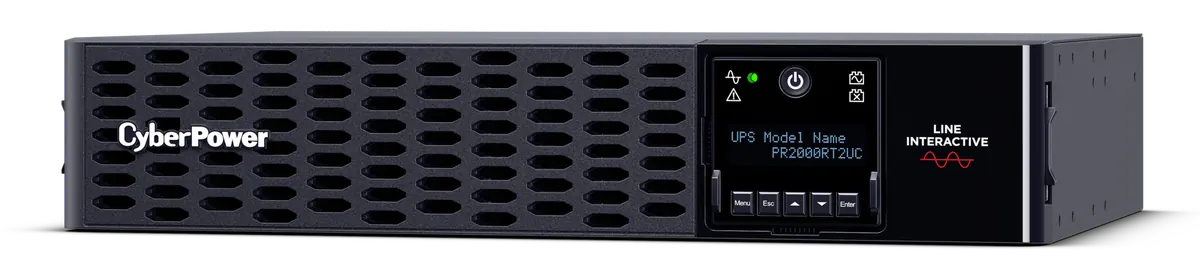
Decide whether the rack needs another 500 W
CyberPower PR1500RT2UC and PR2000RT2UC share a product family, rack/tower format and several management features. The larger unit's useful distinction is its higher supported load. It also changes the specified supply connector. That makes this comparison a decision about measured demand and installation scope, with battery time checked separately. A higher number does not make the larger model the automatic choice for every small rack.
This comparison uses manufacturer documentation for the complete US C models. We have not performed runtime, noise or power-quality tests. Keep the suffixes intact when comparing offers, especially where a seller also lists CN packages with included management hardware or RTXL versions with different battery provisions. The delivered configuration should be clear before its quote is compared with the other chassis.
The core capacity and connector differences
The PR1500RT2UC page lists 1,500 VA / 1,500 W with a NEMA 5-15P input and eight NEMA 5-15R outputs. The PR2000RT2UC page lists 2,000 VA / 2,000 W with a NEMA 5-20P input and eight NEMA 5-20R outputs. Both identify nominal 120 V operation, line-interactive topology and sine-wave output.
| Documented difference | PR1500RT2UC | PR2000RT2UC |
|---|---|---|
| Capacity | 1,500 VA / 1,500 W | 2,000 VA / 2,000 W |
| Input plug | NEMA 5-15P | NEMA 5-20P |
| Eight output receptacles | NEMA 5-15R | NEMA 5-20R |
| Manufacturer half-load reference | 18.2 min at 750 W | 13.5 min at 1,000 W |
| Manufacturer full-load reference | 6.5 min at 1,500 W | 4.5 min at 2,000 W |
| Replacement cartridge | RB1290X4J | RB1290X4J |
A measured 1,650 W load exceeds the smaller model's watt limit and sits 350 W below the larger model's limit. That is a straightforward reason to consider PR2000RT2UC, assuming VA and all installation requirements also fit. A rack measured at 1,100 W fits either watt ceiling. For that rack, the useful next questions are runtime, future documented demand and the cost of the complete installation.
Do not turn the arithmetic difference into a universal recommended margin. Measure the important operating states, including backups, heavy storage work and source failure. If redundant equipment transfers more demand to the surviving UPS, size for that stated requirement. A comparison made only from ordinary shared-load readings can approve a configuration that has no documented support for its intended failure condition.
Moving to 20 A needs site confirmation
The input change is the practical hurdle for many replacements. A rack already using a 5-15 connection does not establish a suitable source for the specified 5-20P input. Have the facility professional check the circuit, receptacle and manufacturer's instructions for the proposed unit. Include approved electrical work and scheduling in the comparison rather than assuming the UPS chassis is the whole purchase.
CyberPower's current PR2000RT2UC specification names 5-20P, while its contents list also names a 5-20P adapter. Ask the supplier to confirm the delivered cord arrangement and included manufacturer accessories against the current manual. That is preferable to importing a plug description from a differently suffixed listing. Keep the confirmed arrangement with the installation record so the maintenance team knows what is actually on site.
Check the downstream connections too. The larger model's 5-20R outputs should be matched to the intended equipment and approved distribution arrangement. An outlet schedule needs actual plug types and cord count, particularly for redundant supplies. Receptacle count is a convenience feature, not an increase beyond the single total capacity limit.
The runtime columns do not use equal loads
The manufacturer's half-load figures are 18.2 minutes for PR1500RT2UC and 13.5 minutes for PR2000RT2UC. Those numbers represent 750 W and 1,000 W respectively. Their full-load references likewise use different watts. Comparing the displayed minutes without carrying the load into the comparison can make a capacity upgrade look like a battery-performance result that the figures do not establish.
For a rack measured at 900 W, consult both exact-model runtime resources at 900 W. Keep the battery configuration and conditions visible. The shared RB1290X4J replacement cartridge is useful for a service inventory, but it does not prove equal efficiency, equal discharge behavior or equal duration at that demand. We have not measured either unit, so this comparison assigns no runtime winner from cartridge identity.
CyberPower qualifies runtime curves as approximate and based on fully charged new batteries under normal conditions. An installed system with aging batteries needs an acceptance and maintenance process appropriate to its task. Define the shutdown duration or continued-operation target, then check the planning data against it. Do not calculate minutes by dividing VA by the equipment load.
A practical shutdown plan lists outage detection, application stops, storage completion, host shutdown and the network services needed for communication. Time the complete sequence under approved site procedures. Then define the threshold that initiates it and the recovery behavior when power returns. A few extra supported watts do not compensate for a sequence whose duration has never been established.
Match optional management on both quotations
Both C-model pages describe built-in cloud monitoring and optional RMCARD205 network management. Put the optional card on both quotes if it is required for the site. A comparison between a bare unit and a card-equipped seller bundle is incomplete until the difference is priced and documented. The word remote on a feature list is not a complete shutdown design.
Confirm current PowerPanel Business support for the operating systems and virtualization environment. A local USB host and several networked hosts have different communication needs. Map the switches and services required to deliver commands, and make sure they remain supported until the sequence ends. Configure alert recipients and access ownership during commissioning rather than leaving the dashboard unattended after installation.
Similar format still requires a complete contents check
Both are 2U rack/tower products. Review the current drawings and mounting instructions for the actual rack, even when the intended replacement appears similar. Check usable depth, rear clearance and front battery access. Require the seller's delivered-parts list for rails, brackets, tower supports and cables. Used listings need particular attention because a stock photo does not document the available mounting package.
The shared replacement-cartridge number can simplify a site's battery inventory when both exact models are installed, but record each chassis and its battery history separately. Follow each current service procedure and the site's change controls. A replacement cartridge's compatibility does not make every old battery equally serviceable or establish that a secondhand unit arrives ready for the intended runtime task.
For a branch office planning additional equipment, attach a specific growth inventory to the decision. Identify the proposed device, its supported operating demand and when it will be installed. That gives the larger capacity a measurable purpose. Also compare the work needed to put each complete system into service: facility review, mounting parts, management card, configuration and commissioning. A higher-capacity chassis that needs a separate electrical visit is a different procurement package from a replacement using an already approved source. Record those differences without treating either project as inherently preferable; the required load and operating task decide which work is justified.
Choose PR1500RT2UC when both measured limits fit and its documented battery configuration supports the required job. Choose PR2000RT2UC when the additional capacity resolves an identified need and the 20 A installation is confirmed. If runtime is the unresolved requirement, compare supported configurations at equal watts before changing models. The individual PR1500RT2UC review and PR2000RT2UC review provide separate quote and installation checks.
Check the exact models
Confirm the model suffix, electrical configuration, seller, condition, included hardware and warranty. These are Amazon.com model searches; results can include alternatives.
Sources and research basis
- CyberPower PR1500RT2UC official US specificationsPrimary documentation · checked 15 October 2026
- CyberPower PR2000RT2UC official US specificationsPrimary documentation · checked 15 October 2026
- CyberPower PR1500RT2UC official datasheet resourcePrimary documentation · checked 15 October 2026
- CyberPower PR2000RT2UC official datasheet resourcePrimary documentation · checked 15 October 2026
- CyberPower PR2000RT2UC official manual resourcePrimary documentation · checked 15 October 2026
Manufacturer specifications describe the documented configuration. Buying recommendations are our interpretation of those features. No original runtime, acoustic, efficiency, switching or software test is claimed. Report a correction.