What should drive the choice?
Shortlist PR1000RT2UC for a measured load within both 1,000 limits and a verified runtime target. Confirm management hardware and mounting contents before treating a seller package as complete.
Research based on linked manufacturer documentation. We have not physically tested this equipment.
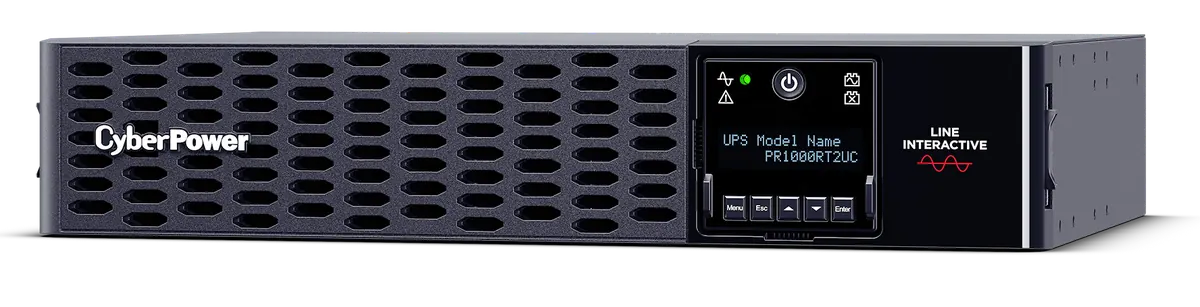
A compact rack decision with two capacity limits
The CyberPower PR1000RT2UC deserves consideration for a small server, storage and network installation whose measured demand fits a 1,000 W UPS. Its rack/tower format and ordinary-looking input connector make it easy to shortlist. The more important decision is whether the complete arrangement provides enough battery time, an appropriate shutdown path and access for service. Those requirements make a specification useful to an actual buyer.
This review is based on manufacturer material for the exact US PR1000RT2UC. We have not operated the unit, measured its sound or performed a battery discharge. Published minutes below remain manufacturer figures. Our analysis focuses on what belongs in a quote and acceptance plan, so a buyer can distinguish a suitable system from a chassis that merely has an appealing feature list.
1,000 VA and 1,000 W are both real boundaries
The official product page specifies 1,000 VA / 1,000 W, line-interactive topology, sine-wave output and a nominal 120 V input. It identifies a NEMA 5-15P plug on a ten-foot cord, eight NEMA 5-15R battery-backed outlets and a 2U rack/tower chassis. These exact-model details should accompany the model number on the purchase request.
The equal VA and watt figures simplify the label but do not eliminate the need to measure both. An illustrative load of 700 W and 900 VA fits both stated limits. A load of 850 W and 1,050 VA does not fit the apparent-power limit even though its watts are below 1,000. Those examples are sizing arithmetic, not measurements of equipment attached to this UPS. Record the actual protected load before drawing the same conclusion for a real rack.
Include the demand from storage activity, scheduled jobs and failure states. For equipment with redundant supplies, establish how much load this UPS must support when the other source is unavailable. A comfortable normal-operation reading can give an incomplete picture. If a planned addition is known, record it as an explicit requirement rather than relying on a general intention to leave headroom.
Compared with the APC SMT1500RM2UC, this model has a different VA limit despite the same published 1,000 W ceiling. That is why comparing 1000 and 1500 family names alone is unhelpful. Use actual VA, watts, runtime and the needed management configuration. No product-name comparison establishes which unit is more reliable or which performs better with your equipment.
Published minutes need a defined job
CyberPower publishes 19.5 minutes at half load and seven minutes at full load. For this model those reference loads correspond to 500 W and 1,000 W. Its runtime note says the curve is approximate and based on fully charged new batteries under normal conditions, with variation from age, charge and environment. Treat those figures as planning references rather than a promise for every installed unit.
The useful question is what happens during those minutes. Write a sequence covering the application stop, storage completion, host shutdown and final network state. Time the real process using approved commissioning procedures. A network-only site might instead define a continuity target. In either case, the resulting requirement gives the published curve something meaningful to answer.
A load between the published reference points needs the model-specific runtime resource. Do not assume battery minutes scale linearly with watts or that a percentage from a larger UPS represents the same demand. Also plan what happens after an interruption: who verifies recovery, whether all equipment restarts automatically and how the site operates while batteries recharge. A first successful shutdown is only one part of outage readiness.
Use the outlet groups intentionally
The manufacturer lists eight battery-and-surge outlets, including four critical-load outlets. That offers a useful starting point for deciding which devices need the longest remaining support. Read the manual's grouping and configuration instructions before assigning equipment. An outlet label is not enough to establish that the intended automatic shedding policy has been configured or that its timing matches the workload.
Map every cord to the device it serves and record why the device needs backup. Keep the switch used for shutdown communication in the protected group. A display or accessory that can stop early should not consume the reserve intended for storage. Those choices make the available energy serve a deliberate task rather than whichever devices happen to be plugged in first.
Eight outlets also share one total UPS budget. They are not eight separate sources of 1,000 W, and redundant cords connected to the same chassis do not establish independent A/B power. If source redundancy is part of the project, document the two paths and their failure behavior. Then check the load this unit carries when the other path is lost.
C and CN packages answer different management questions
PR1000RT2UC includes built-in cloud monitoring, while CyberPower identifies RMCARD205 as optional for network management. Its separate PR1000RT2UCN listing specifies an included RMCARD205. Keep those suffixes visible in quotes. A base C listing should not be costed as a complete network-card package merely because it has a cloud connection.
For a local USB shutdown arrangement, confirm the current PowerPanel Business support for the intended operating system and the supplied cable. For a multi-host environment, list the card, software and network dependencies needed to reach every host. Ask the supplier to identify the complete configuration rather than answering only that the UPS supports remote management.
Decide how management works when internet access fails. Establish alert ownership, account access and recovery procedures. Test the intended shutdown outcome under the site's controlled commissioning plan. A cloud page showing healthy status does not establish that every workload stops in order. This distinction is particularly important at an unattended location where the person receiving the alert is not beside the rack.
A moderate depth still needs a measured fit
CyberPower lists dimensions of approximately 434 mm wide, 86 mm high and 411 mm deep, with a weight of 50.1 lb. Its package list names a two-post rack mounting kit and tower mounting kit. Use the current installation instructions to confirm support for your actual rack. A new-product contents list does not establish which parts accompany a used or open-box shipment.
Measure usable cabinet depth, rear connector clearance and the path of the input cord. A wall cabinet's external measurement does not tell you its available mounting space. Plan safe handling using the manual and site procedures, and leave access to the front battery area. The initial fit should still allow a future technician to service the unit without dismantling unrelated equipment.
Battery service belongs in the comparison
The official specification identifies RB1270X4H as the replacement cartridge and describes user-replaceable, hot-swappable batteries. Follow the exact manual procedure and site change controls; that feature description is not permission to improvise battery work. Confirm compatibility again when ordering a replacement and keep the cartridge number with the equipment inventory.
For a previously owned UPS, request the battery history, actual accessory contents and clear identification photos. A chassis model number alone says little about the remaining battery condition. Compare the complete package, required card, replacement battery and service arrangements against alternatives. Avoid treating an unverified battery as equivalent to a documented new unit simply because both listings use PR1000RT2UC.
The buying conclusion is favorable when the measured watts and VA fit, the published runtime supports a verifiable task and the management path is fully specified. Move to another documented configuration when either capacity limit fails or the required duration is unsupported. The PR1500RT2UC is a useful adjacent comparison, but any upgrade still needs the same load, runtime and installation checks.
Check the exact models
Confirm the model suffix, electrical configuration, seller, condition, included hardware and warranty. These are Amazon.com model searches; results can include alternatives.
Sources and research basis
- CyberPower PR1000RT2UC official US product specificationsPrimary documentation · checked 15 October 2026
- CyberPower PR1000RT2UC official datasheet resourcePrimary documentation · checked 15 October 2026
- CyberPower PR1000RT2UC official user manual resourcePrimary documentation · checked 15 October 2026
- CyberPower PR1000RT2UCN official product pagePrimary documentation · checked 15 October 2026
Manufacturer specifications describe the documented configuration. Buying recommendations are our interpretation of those features. No original runtime, acoustic, efficiency, switching or software test is claimed. Report a correction.