What should drive the choice?
Consider PR2000RT2UC for a documented 120 V installation that meets its input requirements and supports the measured load within both 2,000 limits. Specify management and runtime acceptance before buying.
Research based on linked manufacturer documentation. We have not physically tested this equipment.
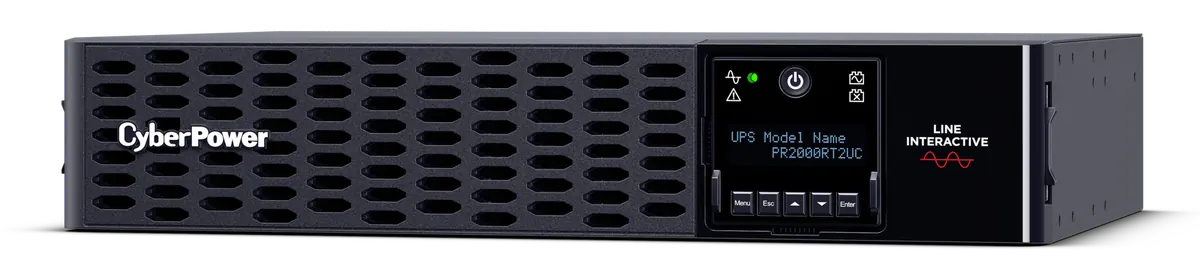
The input requirement belongs beside the watt figure
The CyberPower PR2000RT2UC is a candidate for a rack that needs more output capacity than a 1,000 W or 1,500 W UPS provides. Its most useful buying question is whether the site has the correct installation for it. A capacity upgrade that also changes the supply connection needs coordination with the facility owner. Confirm that part of the project before deciding that the unit is a straightforward replacement.
This is a manufacturer-source buying review of PR2000RT2UC, including its final C suffix. It does not describe the older PR2000RT2U, a CN package or a regional E model. We have not performed discharge, acoustic or equipment-compatibility tests. The assessment separates the published specification from the acceptance work needed to prove that the selected configuration meets a particular site's outage objective.
The exact model is 2,000 VA and 2,000 W
The official US product page specifies 2,000 VA / 2,000 W, nominal 120 V input, line-interactive topology and sine-wave output. It lists a NEMA 5-20P input, a ten-foot cord and eight NEMA 5-20R battery-backed receptacles. Four outputs are identified as critical-load outlets. These details describe one shared UPS capacity, regardless of how many connections are occupied.
An illustrative rack at 1,650 W is 350 W below the published watt limit. That difference is arithmetic capacity remaining, not an endorsed growth allowance or a runtime estimate. A rack at 2,050 W exceeds the limit even if its average demand is lower. Check VA separately and measure the operating states that matter to the installation, including scheduled work and equipment restart.
A redundant-power installation needs a failure-state calculation. If one source disappears, determine which loads move to this UPS and how much they draw. Normal readings with two healthy sources can understate the required support. Write that assumption into the procurement record so a later technician understands whether this unit was selected for normal sharing, complete failover or another defined operating condition.
Confirm the 20 A connection and the delivered cord arrangement
The manufacturer identifies a 5-20P input in the current specification and also names a 5-20P adapter in the package contents. Ask the supplier to confirm the delivered input arrangement and all included manufacturer accessories against the current manual. Do not infer a different plug from a similar model's listing, and do not make the installation dependent on an unspecified third-party adapter.
Have the responsible facility professional check the receptacle, circuit and manufacturer installation requirements. An existing 120 V outlet is not sufficient information. Record the approved connection and cord route, including access after the rack's rear door is closed. If facility work is required, include it in the budget and schedule before the UPS delivery date becomes a maintenance commitment.
Output capacity does not define the allowable load on the building circuit by itself. The complete installation includes the UPS and its operating requirements, so use the manufacturer instructions and the site's electrical review. This is a procurement coordination point, not a reason to derive an input-current allowance by dividing 2,000 W by nominal voltage and treating the result as an installation rule.
The published full-load window is short enough to require a plan
CyberPower publishes 13.5 minutes at half load and 4.5 minutes at full load. On this model those reference points correspond to 1,000 W and 2,000 W. The manufacturer's runtime note describes approximate results using fully charged new batteries under normal conditions, with variation from battery age, charge, environment and other factors. These are manufacturer figures, not RackHeadroom measurements.
A four-and-a-half-minute reference makes the shutdown workflow a concrete selection issue. Establish how long applications need to stop, how long storage takes to finish writes, and when hosts can safely power off. Add the network devices that carry shutdown commands to the supported-load inventory. A UPS that keeps the server energized while its required switch has already stopped does not satisfy a coordinated shutdown requirement.
Use the exact runtime resource at the actual watt load. Do not interpolate by simple proportional arithmetic or compare half-load minutes with a unit whose half load represents fewer watts. Define whether the goal is a brief ride-through, a completed shutdown or continued operation for a stated interval. Then make that goal part of commissioning under the site's approved test process.
Recovery also deserves attention. Decide who checks battery status after an event, how equipment restarts and what operating restrictions apply until sufficient charge returns. A site exposed to repeated interruptions needs that procedure written down. The initial discharge window and readiness for the next event are separate acceptance questions, and a larger VA label does not answer either one.
Eight receptacles still require a device schedule
Prepare an outlet map that assigns essential network, storage and compute devices intentionally. Use the manual to understand how critical-load and other outlets are controlled before relying on load shedding. The distinction can support a useful policy only when the configured behavior matches the shutdown sequence. Merely plugging a device into a labelled group does not document the intended outcome.
Check the equipment's actual plug types and any approved downstream distribution. Eight receptacles do not necessarily serve eight equipment assemblies if devices have multiple power supplies. They also do not create separate power paths. If the project requires A/B resilience, show both sources and verify what this UPS carries after a failure. Keep labels consistent between the diagram, the rack and the purchasing record.
Budget the management path that the site uses
The exact-model page describes built-in cloud monitoring and an optional RMCARD205 for network management. It also lists USB, serial and PowerPanel Business provisions. Treat the optional card as a separate purchase item unless the actual seller explicitly includes it. Do not use a CN listing's included hardware to describe the base C model.
For local shutdown, confirm current operating-system support and the correct communication cable. For several servers or virtualized systems, specify the network card, software and dependency sequence that reaches every workload. Ask for the exact supported arrangement. An answer that the unit has remote monitoring does not establish that it can perform the shutdown architecture your project requires.
At an unattended location, define who receives notifications and who has access to change settings. Establish what remains manageable during an internet outage. Commission monitoring and shutdown as separate outcomes, including recovery after mains returns. This gives the person responsible for the equipment a clear procedure instead of leaving the operating plan implicit in a software installation.
Rack fit and battery replacement affect the complete purchase
CyberPower lists a 2U rack/tower format, approximately 434 by 86 by 411 mm chassis dimensions, and 59.8 lb physical weight. Its contents list includes rack and tower mounting components. Verify the mounting arrangement against the current manual and the actual rack, then ask the seller to enumerate included parts. This matters particularly for equipment sold outside a complete new retail package.
Measure usable depth and rear cable clearance rather than relying on cabinet exterior dimensions. Plan safe handling and service access using the installation instructions. Leave the front battery area accessible, and think through removal of the complete chassis. A layout that works only before adjacent equipment is fitted does not provide a useful long-term service arrangement.
The official replacement cartridge is RB1290X4J, and CyberPower describes the batteries as user-replaceable and hot-swappable. Follow the manual's procedure and site change controls. Keep the cartridge identity and battery history with the equipment record. For a used unit, require evidence of battery condition and package contents before comparing it with a documented new configuration.
PR2000RT2UC is worth shortlisting when the measured load fits both limits, the 20 A installation is confirmed and the runtime supports a defined task. Compare the APC SMT2200RM2UC with its capacity caveat intact, and compare the PR1500RT2UC only if the smaller capacity meets the requirement. The best order names the complete management, mounting and battery configuration and has an acceptance procedure ready before delivery.
Check the exact models
Confirm the model suffix, electrical configuration, seller, condition, included hardware and warranty. These are Amazon.com model searches; results can include alternatives.
Sources and research basis
- CyberPower PR2000RT2UC official US product pagePrimary documentation · checked 15 October 2026
- CyberPower PR2000RT2UC official datasheet resourcePrimary documentation · checked 15 October 2026
- CyberPower PR2000RT2UC official user manual resourcePrimary documentation · checked 15 October 2026
- CyberPower official PR2000RT2UC runtime referencePrimary documentation · checked 15 October 2026
Manufacturer specifications describe the documented configuration. Buying recommendations are our interpretation of those features. No original runtime, acoustic, efficiency, switching or software test is claimed. Report a correction.