What should drive the choice?
A relevant shortlist choice when individual outlet control is a requirement. Confirm the embedded management platform, firmware support and eight-outlet fit before ordering.
Research based on linked manufacturer documentation. We have not physically tested this equipment.
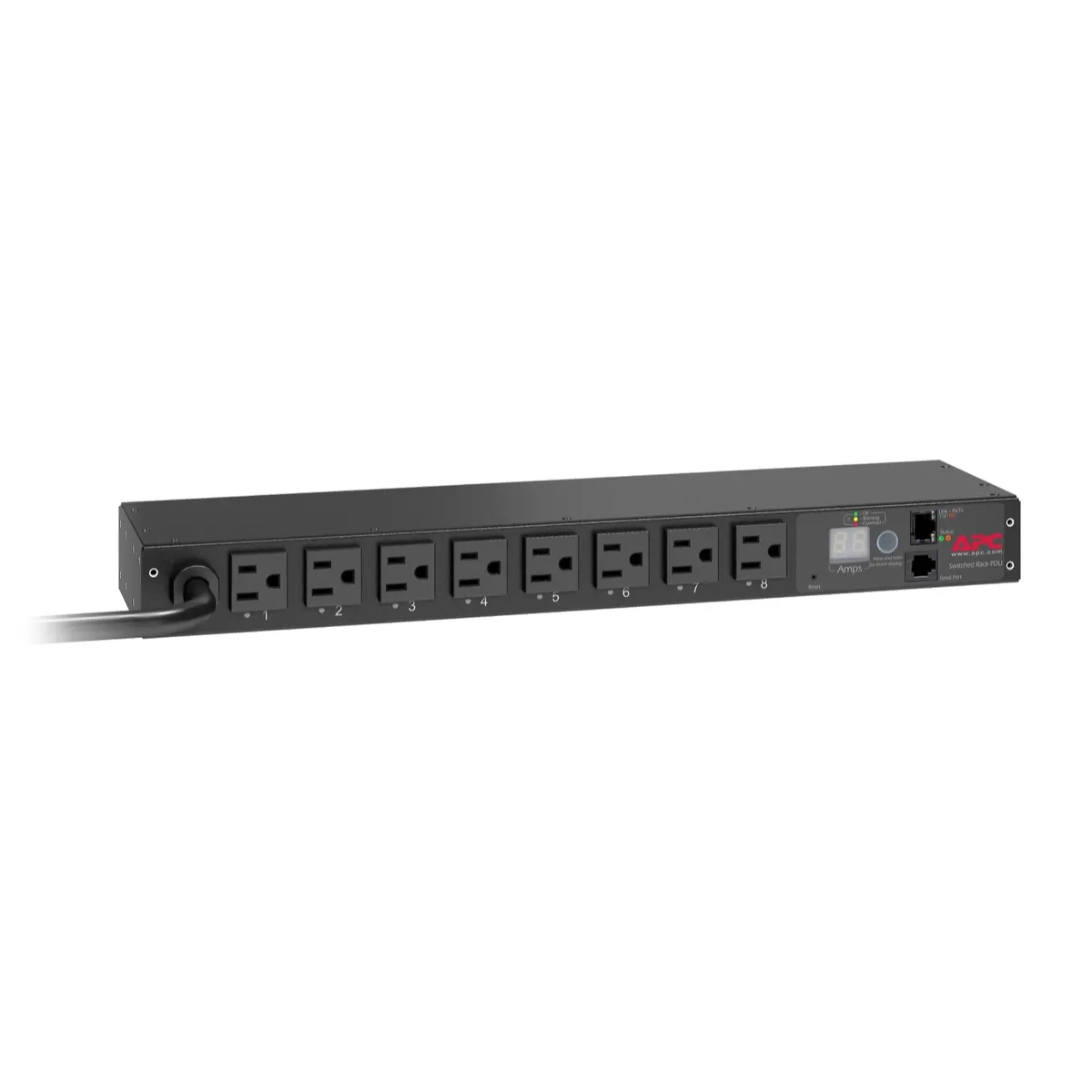
What the AP7900B is for
The APC AP7900B belongs on a shortlist when an unattended rack needs individual outlet control. It distributes a compatible US 120V source to eight NEMA 5-15R receptacles and allows supported remote on and off actions. That can support recovery of a locked appliance, controlled startup sequencing or disabling an unused outlet. It is a specific operational tool, so a purchase should begin with the action the technician needs to perform rather than a broad preference for a smart power strip.
The suffix matters. This article concerns AP7900B, which has a current Schneider Electric US product page. It does not assume that an older AP7900, an AP7901B or another region's configuration has identical electrical ratings, firmware or accessories. This review analyzes documentation rather than a tested sample. We have not measured switch latency, authenticated to its interface or verified behavior through a loss of management connectivity.
Ratings and physical facts to check first
The AP7900B overview and specifications distinguishes a 12A UL maximum input from the 15A PSE figure. US buyers should not turn the 15A nameplate class into a 15A continuous rack plan. The input is NEMA 5-15P and the nominal input range is 100 to 120VAC. At nominal 120V, 12A is 1.44kVA of apparent power. The model page rounds the class to 1.4kW; do not use that shorthand to ignore equipment power factor or upstream limitations.
| Item | Documented AP7900B configuration | Buying consequence |
|---|---|---|
| Output layout | Eight NEMA 5-15R outlets | Reserve enough receptacles for every supply |
| Input | NEMA 5-15P; nominal 100 to 120VAC | Match the source exactly |
| US current limit | 12A UL in the overview specification | Treat 15A as the product class, not a persistent target |
| Cable | 12ft attached power cord | Measure the routed distance |
| Mounting envelope | 1U; approximately 4.25in chassis depth | Add output plug and cable clearance |
| Primary feature | Outlet on/off switching | Useful for deliberate recovery workflows |
What individual switching changes
A remote outlet command can eliminate a site visit for the right problem, but only if the affected device is safe to power-cycle and the management path remains reachable. An outlet feeding a firewall is a different operational decision from one feeding a storage array. Write a device-specific recovery procedure and identify who can authorize it. The PDU cannot know whether an application has finished writing data or whether another administrator is performing maintenance.
Keep the management switch, router and any required modem in the recovery diagram. If the only path to the PDU passes through the appliance being rebooted, a power action can interrupt the connection needed to complete the work. A scheduled restoration or verified recovery mechanism may help in a suitable configuration, but do not assume it from the presence of a reboot button. Confirm behavior in the current manual and validate the actual deployment during an approved maintenance window.
Current monitoring is not device-level accounting
Schneider advertises current metering accuracy of plus or minus five percent on the current product page. That is useful context for aggregate capacity observation, but it is not an independent accuracy test. It also does not establish that every outlet has its own energy meter. Individual switching and individual measurement are separate hardware capabilities. If chargeback, per-server efficiency analysis or device-level kilowatt-hours are the objective, obtain explicit confirmation of the required measurement granularity before purchase.
Use a measured current trend to answer operational questions such as whether a planned equipment addition leaves enough headroom or whether failover increases the surviving feed's load. A single reading during an idle period cannot answer those questions. Record the relevant workload, source voltage and sampling context. A monitoring system becomes useful when the team knows which threshold requires action and who owns the response. Merely collecting a number does not prevent an overload.
Treat the management interface as maintained infrastructure
The embedded management system is part of the purchase, not an incidental extra. Ask which hardware revision and firmware are supplied, how updates are obtained, whether current software supports your monitoring platform and which protocols can be disabled. A listing that says web managed does not prove compliance with an organization's authentication or encryption requirements. Check the exact current documentation rather than copying a protocol list from a different APC PDU generation.
Before deployment, plan addressing, naming, time synchronization, administrative access and alert routing. Limit access to the management environment appropriate for the site. Use named operational ownership so a replacement administrator can find firmware records and configuration backups. These are deployment recommendations, not claims that the AP7900B has passed our security assessment. We have performed no penetration test or audit of this device.
Eight outlets and a shallow body still need planning
Eight outputs may be enough for a small edge rack, but redundant power supplies consume receptacles quickly. Count plugs independently on the A and B sides and label them before installation. If the same device uses two outlets, the labels should explain which supply each outlet serves. Avoid names such as server one without a supply designation, because that ambiguity becomes dangerous when someone is issuing remote power commands.
The 1U format and roughly 4.25in chassis depth can suit a compact cabinet. Nevertheless, leave room for the connected plugs, their bend radius, retention hardware and the network cable. Check whether the front or rear orientation gives technicians clear access without crossing data cabling. The 12ft input cable also needs a route that protects it from pinching and leaves both source and destination identifiable. A physical layout drawing can reveal these issues before the PDU arrives.
When to choose a different tier
If the only requirement is ten convenient outlets and no remote action, the AP9562 basic PDU is a more direct functional match. If network load reporting is needed but outlets should remain unswitched, consider a monitored unit such as Eaton PDUMNH15. Neither comparison is an assertion about current price or reliability. It is a way to avoid buying a feature that the operating process does not need.
For another switched 120V candidate, examine Eaton PDUMH15NET2LX and the CyberPower PDU41001. Compare the entire control workflow, including permissions, documentation, firmware ownership, cable placement and failback behavior. Do not choose between them on outlet count alone, and do not assume that two eight-outlet products share identical management features or sensor support.
Questions for a seller or integrator
- Does the exact product label say AP7900B?
- Which management hardware and firmware revision will arrive?
- Are the installation hardware and any advertised retention parts included?
- Does the 12ft input route fit without changing the approved power arrangement?
- Are all eight outlet destinations documented and individually identifiable?
- Who maintains updates, configuration backups and authorized outlet actions?
For used equipment, request clear photographs of the model label, cord, receptacles and management interface. A successful power-on demonstration does not establish clean configuration, current firmware or the absence of damage. Verify the manufacturer's support position for that exact revision and plan a controlled acceptance check. Do not infer the condition of a specific listing from this specification review.
Verdict
The AP7900B offers a clear capability: network-controlled switching for eight compatible rack loads in a compact US 120V format. It makes sense when the organization can define safe power actions and maintain the management plane. It makes less sense when the real need is simply more outlets, a different connector class or per-outlet energy measurement. Confirm the electrical limit, complete model suffix and management support before treating it as the answer to a remote-site recovery problem.
Check the exact models
Confirm the model suffix, electrical configuration, seller, condition, included hardware and warranty. These are Amazon.com model searches; results can include alternatives.
Sources and research basis
- Schneider Electric US AP7900B product pagePrimary documentation · checked 15 October 2026
- AP7900B and AP7901B overview and specificationsPrimary documentation · checked 15 October 2026
Manufacturer specifications describe the documented configuration. Buying recommendations are our interpretation of those features. No original runtime, acoustic, efficiency, switching or software test is claimed. Report a correction.