What should drive the choice?
Consider the SMT1500C for a 120 V tower installation with a measured load below both rated limits and a clear shutdown plan. Choose a rack model when rack mounting is a requirement.
Research based on linked manufacturer documentation. We have not physically tested this equipment.
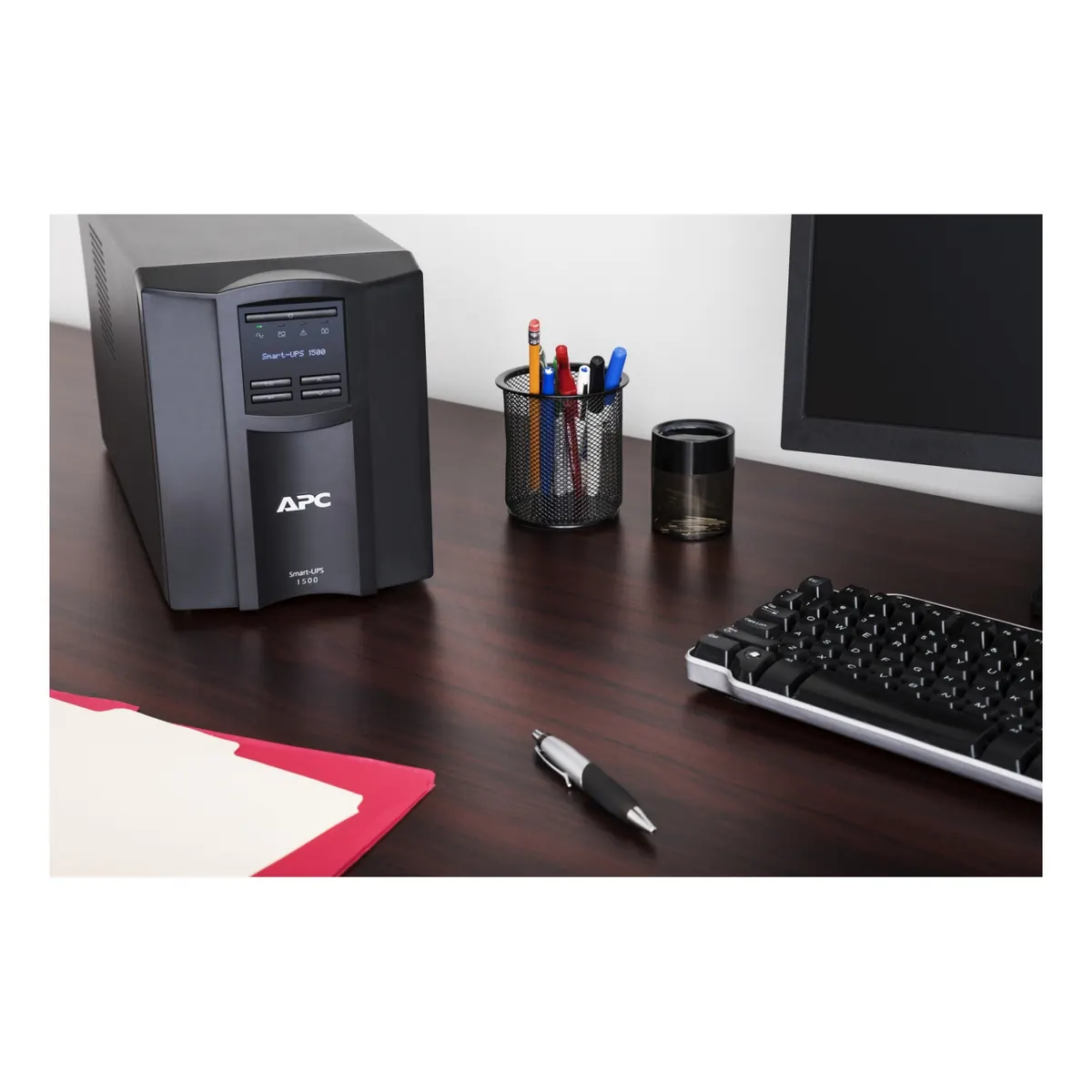
Start with the tower installation
The APC SMT1500C is a useful model to assess when the protected equipment does not live in a rack. A small server, storage appliance and network stack may need battery backup without needing rack rails. In that case, buying a rack UPS and improvising a shelf can add complexity without solving a real requirement. The tower model deserves a separate decision based on placement, access and its actual output limit.
Do not confuse SMT1500C with SMT1500RM2UC, SMT1500IC or another regional variant. The complete model number belongs in the purchase order. This review concerns the US 120 V tower configuration and published manufacturer specifications. We have not handled a sample, measured fan noise or conducted a runtime test. The recommendation addresses documented suitability, not a claim of independently proven endurance or reliability.
The 1500 name still means a 1,000 W ceiling
Schneider's US SMT1500C page specifies a 1,440 VA / 1,000 W line-interactive sine-wave tower UPS with eight NEMA 5-15R outlets. The nominal supply is 120 V, and the exact-model specification identifies a NEMA 5-15P input. Those are the core purchase facts. The family name must not become a 1,500 W promise in a comparison spreadsheet.
Consider two illustrative installations. A small server and network load measured at 550 W has 450 W of arithmetic difference below the watt rating. A workstation and storage stack measured at 1,080 W exceeds it. Both may be advertised casually as a small office setup, but they are different electrical loads. The first still needs VA and runtime checks. The second should not be justified by counting available receptacles or referring to the 1500 label.
Capture real operating states rather than adding only the typical idle figures from equipment reviews. Storage activity, processor work and power-supply redundancy changes can alter demand. Document expected additions as specific equipment or load assumptions. A vague promise to leave some headroom is less useful than a written plan that explains how the requirement was measured and when the selection should be revisited.
Placement is the main difference from a rack UPS
A tower can simplify a small installation, but it still needs a deliberate location. Use the current dimensions and ventilation requirements in the manufacturer documentation to check the actual space. Do not place it where cables become a trip hazard, a front panel is inaccessible, or stored supplies can block ventilation. The protected equipment should remain easy to identify without moving a heavy battery-backed unit.
For an equipment room, think about normal service access. Can someone read the display, reach the input connection and replace a battery using the approved procedure? Can the unit be removed without disconnecting unrelated equipment? These questions can make a modest tower arrangement more maintainable than a crowded improvised shelf. They also help decide whether a dedicated rack model is worth its different footprint.
Noise is often part of a tower purchase because the unit may share a room with people. We have no measured acoustic result for this model and do not label it silent. If desk-side noise is a deciding factor, seek exact operating-mode information and a suitable return policy, or place the equipment in an appropriate separate space. A passive product photograph cannot establish how it sounds during charging or battery operation.
Eight outlets are a convenience, not extra capacity
Make a device list before assigning the eight receptacles. Include the network equipment needed to communicate an outage and complete shutdown, not just the most visible server. Then identify devices that can stop immediately and devices that must remain available. This makes the protected-load calculation explainable and helps avoid filling the UPS with nonessential accessories that consume the intended shutdown window.
A bulky adapter can make adjacent receptacles inconvenient even when the outlet count looks sufficient. Review the manufacturer's product photos and equipment plugs before deciding whether all positions are usable in your arrangement. We have not performed a physical adapter-fit test. If an approved distribution arrangement is needed, include it in the electrical design and purchase comparison rather than adding a general-purpose strip after installation.
Remember that two redundant cords connected to this same UPS still share one UPS. If a server or storage system needs independent power paths, define that requirement explicitly. An A/B arrangement requires understanding what happens to loading when either source is lost. The SMT1500C can be part of a suitable plan, but a pair of available outlets does not demonstrate source redundancy.
Monitoring and shutdown solve different tasks
The manufacturer advertises SmartConnect cloud monitoring and local USB or serial shutdown through PowerChute Serial Shutdown. The model also carries a SmartSlot in the official description. Before buying, confirm the current feature terms and any optional management card, software or license needed for your intended environment. Cloud visibility should not be assumed to include every network shutdown function.
For one physical server, a local communication arrangement may be straightforward. For multiple hosts, storage and virtualization, build an integration list rather than assuming one cable will coordinate everything. Check current operating system support and define the order in which workloads stop. The network switch carrying those messages needs enough battery-backed time to remain functional through the process.
Set alert ownership while the system is commissioned. A warning routed to an unused email address does not help the person responsible for recovery. Decide how the team notices battery replacement needs, how a site visit is triggered, and what should happen after power returns. This operational preparation often contributes more to a useful UPS purchase than adding a feature that nobody will configure.
Buy minutes for a task, not a bigger number
Use the exact-model manufacturer runtime curve at your measured watt load. Do not compare a tower's half-load figure with a rack unit's half-load figure unless the watt loads match. At a 1,000 W output rating, half load is 500 W. A 1,500 W UPS uses 750 W for the same percentage label. That mismatch can reverse the impression created by a quick specification comparison.
For shutdown protection, time the real workflow and include a sensible commissioning process under site procedures. For continued operation, define the target interruption and verify that the battery configuration can meet it under applicable conditions. New-battery published curves are planning information, not a guarantee for an aging unit in a warm closet. We do not calculate runtime by dividing VA by load.
The buying verdict is to shortlist SMT1500C when tower placement is intentional, both output limits fit and the shutdown path is supported. Compare the SMT1500RM2UC rack version when mounting in a cabinet matters, and consider a higher watt rating when the measured requirement demands it. Include battery service, management needs, warranty eligibility and actual seller contents in the quote. The right format and documented capacity matter more than choosing the most familiar family name.
Check the exact models
Confirm the model suffix, electrical configuration, seller, condition, included hardware and warranty. These are Amazon.com model searches; results can include alternatives.
Sources and research basis
- Schneider Electric SMT1500C US product pagePrimary documentation · checked 15 October 2026
- Schneider Electric SMT1500C US marketplacePrimary documentation · checked 15 October 2026
Manufacturer specifications describe the documented configuration. Buying recommendations are our interpretation of those features. No original runtime, acoustic, efficiency, switching or software test is claimed. Report a correction.