What should drive the choice?
Shortlist 5PX1500RTG2 when its exact US output limit fits and the documented battery configuration meets the outage target. Include optional management and every enclosure in the installed-system comparison.
Research based on linked manufacturer documentation. We have not physically tested this equipment.
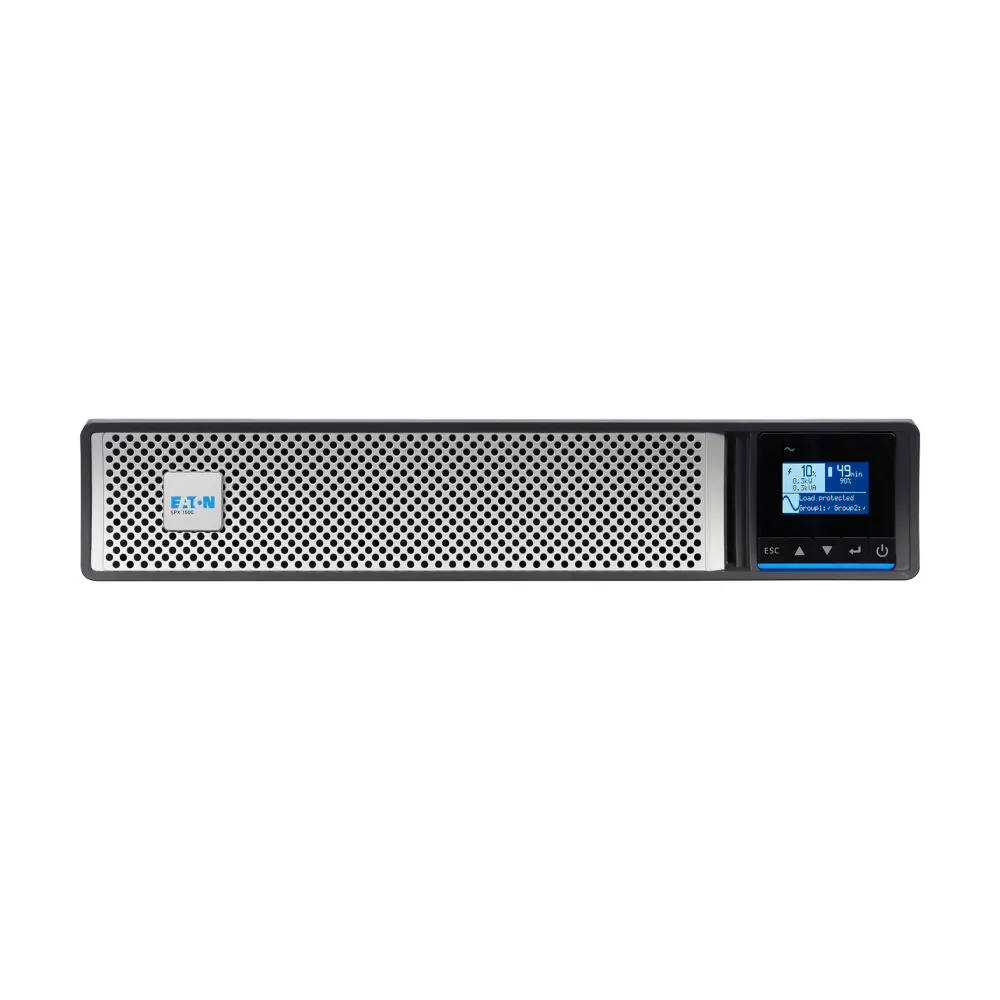
A battery configuration decision as well as a chassis purchase
The Eaton 5PX1500RTG2 deserves a place in a shortlist when a small rack needs an expandable line-interactive UPS. Its useful features are the exact US 1,440 W limit, a documented external-battery option and management choices that can be specified for the site. The buying decision should describe the completed system, because the base UPS and an expanded multi-enclosure installation solve different runtime requirements.
This review covers the complete 5PX1500RTG2 catalog number. It does not substitute the earlier 5PX generation, the higher-voltage H model or the differently named RTNG2 package. We have not measured runtime, sound, efficiency or transfer behavior. The recommendation uses manufacturer facts to define a purchase and commissioning plan that an installer can verify.
Use the exact US 1,440 VA / 1,440 W specification
The current US product page lists 1,440 VA and 1,440 W, nominal 120 V input, NEMA 5-15P input on a ten-foot cord and eight NEMA 5-15R receptacles. The North American technical specification repeats the 1,440 / 1,440 pair. Keep those figures separate from the 1500 family label in a procurement worksheet.
For an illustrative load measured at 1,200 W and 1,300 VA, both stated limits contain the demand. The arithmetic watt difference is 240 W. A load at 1,470 W exceeds the watt limit even though it is below 1,500. Neither example establishes a recommended margin or battery duration. A catalog family's rounded name is not an operating allowance.
Measure meaningful operating states, including heavy processing, storage work and startup. With redundant supplies, determine what happens when the other source is lost. The surviving UPS's demand is the relevant number if full failover is the requirement. Record that assumption and the planned equipment additions so capacity can be reassessed before the rack changes.
The manufacturer identifies line-interactive topology. Battery expansion does not turn this model into online double conversion. If the equipment specification calls for online conversion behavior, choose an appropriate shortlist rather than infer it from the larger battery configuration or the 5PX family position. Conversion architecture and stored energy are independent selection questions.
Up to four exact-compatible EBMs
Eaton's exact-model page permits up to four 5PXEBM48RTG2 external battery modules. The module's own specification explicitly lists 5PX1500RTG2 among compatible UPSs, identifies 2U height and lists its cable, mounting hardware and tower supports. This pairing is stronger evidence than matching a nominal battery voltage or assuming an older generation's enclosure is interchangeable.
Select the module count from a required duration at the measured watt load. Establish whether the system must complete a shutdown sequence, bridge a short interruption or keep equipment operating for a defined period. Use Eaton's runtime data for that complete battery configuration. Do not multiply internal-battery minutes by module count or treat the maximum supported number as a default recommendation.
The footprint grows with the battery plan. A base 2U UPS plus one 2U EBM occupies 4U before other equipment is counted. Additional modules add their own support, cable-routing and access requirements. Eaton lists 61.3 lb for the compatible EBM, so the rack and handling plan need to cover the full system. The smallest chassis description is not the installed-system size.
Include battery service and recovery in the design. Keep an enclosure-by-enclosure inventory and confirm replacement quantities rather than assuming the internal battery order also covers every EBM. Ask for configuration-specific recharge guidance and define operation after an outage while charge recovers. A longer first discharge window does not remove the need to plan for a second interruption.
A graph at the actual watts is the useful comparison
The exact-model Eaton runtime graph identifies 5PXEBM48RTG2 and lets the battery configuration be compared by load. Eaton states that runtimes are approximate and vary with equipment, configuration, battery age and temperature, with actual duration varying around typical values. We have no independent endurance measurements and do not award a runtime result from inverter capacity.
For shutdown protection, time the whole workflow under approved site procedures: detecting the interruption, stopping applications, finishing storage activity and shutting down hosts. Keep the required network path available until commands are complete. A manufacturer's curve becomes useful when the procurement document names the task it must support and the remaining reserve needed to complete it.
For continued operation, specify the target interval and the point at which the system falls back to shutdown. Decide who owns the settings and how changes are reviewed. An expanded battery system with no defined stopping policy can still fail its operational purpose. Commission the intended sequence and restart behavior separately from confirming that batteries are detected.
Use the two controlled segments deliberately
The advanced user guide shows four primary 5-15R outputs plus two two-outlet groups for this capacity class. It documents load-segment start and shutdown settings. Assign devices according to those supported groups and their dependencies; do not infer individual control of every outlet from the fact that grouped control exists.
Map all equipment cords, including devices that need to stay available for communication. A display or accessory that can stop early should have a deliberate place in the sequence. Multiple outlets still share one total power budget. Redundant cords connected to this one chassis remain one UPS path, so an A/B requirement needs a separate diagram and failure-state calculation.
The base model's current network card is optional
The current US specification names one slot with optional Gigabit Network Card Network-M3 and identifies Brightlayer Data Centers suite compatibility. Older manufacturer illustrations can show Network-M2, so confirm the supported current card and firmware for the delivered unit. Specify the actual card in the quote rather than assuming an expansion slot or Ethernet-related marketing description means hardware is included.
Choose the communication architecture before configuring alerts. A USB-connected local host and several networked hosts have different dependencies. Confirm current software support, how commands reach storage and virtualization systems, and who receives actionable battery warnings. A successful network connection is useful monitoring evidence, but commissioning must also demonstrate the workload shutdown outcome.
Plan for the base chassis and the complete stack
Eaton lists a 17.6-inch depth, 17.2-inch width, 3.4-inch height and 50.7 lb weight for the base UPS. Check usable rack depth, rear cables, rail compatibility and service access using current instructions. Ask the actual supplier to enumerate rack hardware, tower supports, communication cables and any optional battery-module connections. A representative product photo does not establish seller contents.
The exact product page names EBP-1613 as the user-replaceable internal battery. Retain that identity and the installed battery history in the service record, and confirm compatibility when ordering parts. Follow the current procedure and site change controls. Previously owned equipment needs a battery-condition and delivered-parts assessment before its runtime is treated as equivalent to a documented new configuration.
Choose 5PX1500RTG2 when the verified US output limits, line-interactive architecture and selected EBM configuration fit the requirement. Compare the 5P1500RC for a compact internal-battery rack alternative, and the APC SMX1500RM2UC for another expandable architecture. Compare complete configurations at equal load and a shared outage objective before selecting the order.
Check the exact models
Confirm the model suffix, electrical configuration, seller, condition, included hardware and warranty. These are Amazon.com model searches; results can include alternatives.
Sources and research basis
- Eaton 5PX1500RTG2 exact US product specificationsPrimary documentation · checked 15 October 2026
- Eaton 5PX G2 North American technical specificationsPrimary documentation · checked 15 October 2026
- Eaton 5PX G2 advanced user guidePrimary documentation · checked 15 October 2026
- Eaton exact 5PX1500RTG2 runtime graphPrimary documentation · checked 15 October 2026
- Eaton 5PXEBM48RTG2 compatible module specificationsPrimary documentation · checked 15 October 2026
- Eaton EBP-1613 battery compatibilityPrimary documentation · checked 15 October 2026
Manufacturer specifications describe the documented configuration. Buying recommendations are our interpretation of those features. No original runtime, acoustic, efficiency, switching or software test is claimed. Report a correction.