What should drive the choice?
Shortlist it for a documented 120 V, 20 A supply and a load that fits the current 1,920 VA / 1,920 W rated fields. Get written confirmation before designing around the higher configurable figures.
Research based on linked manufacturer documentation. We have not physically tested this equipment.
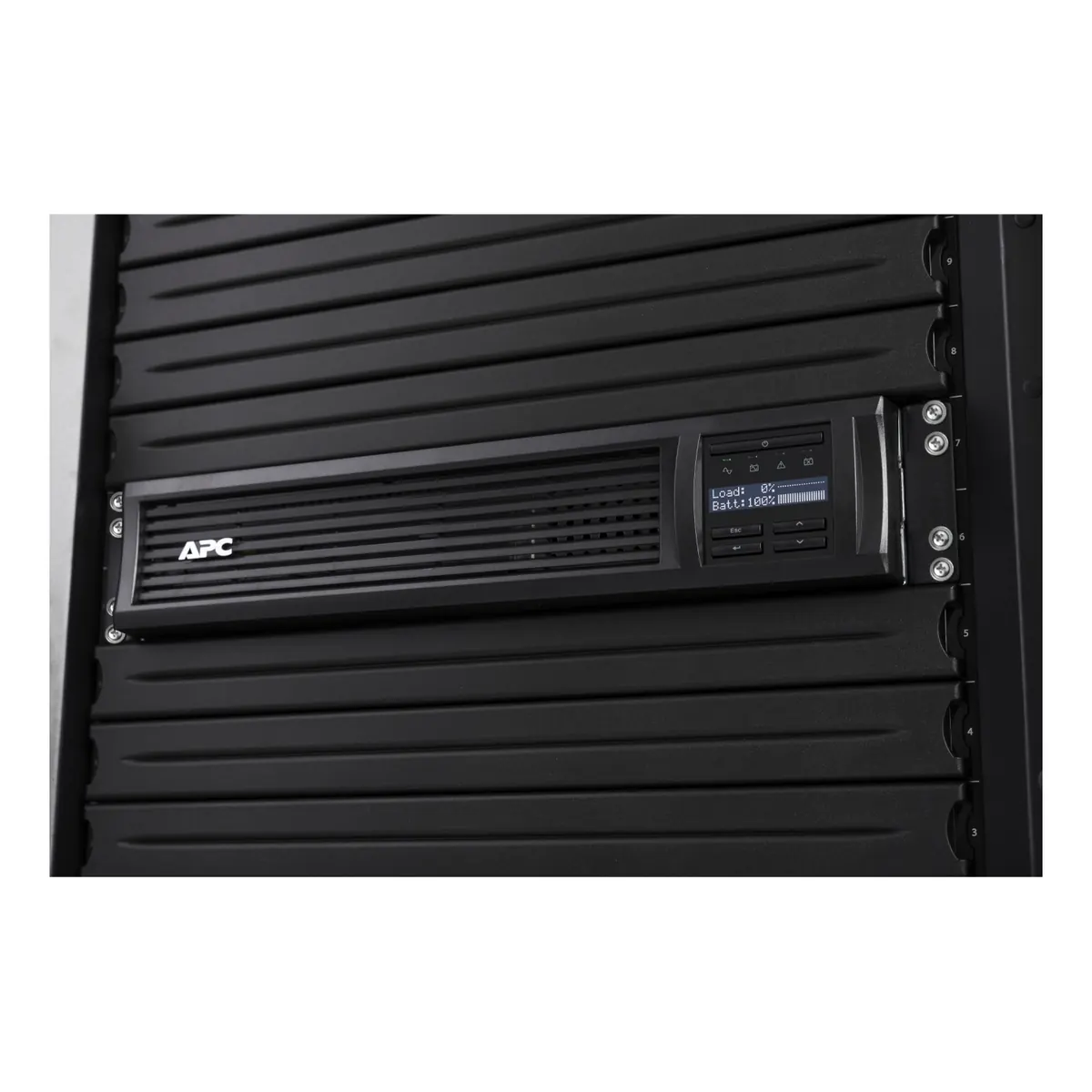
Where this Smart-UPS fits
The APC SMT2200RM2UC belongs on a shortlist for an edge rack or network closet that has outgrown a smaller UPS and already has a suitable supply. Its most important buying question is unusually easy to miss: the current manufacturer documentation contains two different sets of capacity numbers. A procurement specification copied from the product name can therefore disagree with the rated fields used by the person approving the installation.
This review uses published manufacturer material, not a loan unit or a discharge test. Our recommendation is conditional because a model-specific conflict should be resolved before the equipment becomes part of a power design. That approach is useful for a buyer comparing quotes: ask each supplier to identify the exact unit, its applicable rating at the intended voltage, and its included hardware. A confident seller headline is not a substitute for that answer.
The capacity conflict to resolve first
The current US product page describes a 1,920 VA / 1,920 W line-interactive, sine-wave UPS. The manufacturer marketplace specification repeats those rated values but also lists maximum configurable power of 2,200 VA and 1,980 W. We use the lower rated pair for this buying discussion. We do not assume the higher values are an unconditional continuous operating allowance.
Consider an illustrative rack measured at 1,650 W. Against a 1,920 W rating, the arithmetic difference is 270 W. That difference is capacity remaining on paper, not a recommended growth margin or a runtime estimate. A second rack at 1,950 W would exceed the lower rated value even though it sits below the configurable watt figure. Those are meaningfully different purchasing cases, and the second needs manufacturer clarification rather than optimistic interpretation.
Record both watts and VA for the supported load. Then add the expected operating states: normal service, backup jobs, equipment startup, and any failure condition that moves load from another supply. If the project cannot establish those inputs, moving up a model number merely hides an unresolved requirement. Our VA and watts sizing guide helps organize that measurement work without pretending a nameplate is a measured rack.
A 5-20P input changes the project
Schneider specifies a NEMA 5-20P input and eight output receptacles: six 5-15R and two 5-20R. The nominal system is 120 V. These details come from the exact-model official specification, and they should appear in the purchase request alongside capacity. A buyer replacing a UPS connected to an ordinary 5-15 receptacle must verify the site supply before treating this unit as a direct replacement.
Do not solve a supply mismatch by adding an unapproved adapter. Have the facility owner or electrical professional check the receptacle, circuit and installation requirements against the manufacturer documentation. This is a coordination task worth doing before a maintenance window is booked. Discovering the input mismatch after the UPS arrives can leave both the original equipment and the new battery shipment waiting for a second visit.
The mix of output types also calls for a connection schedule. List which device uses each outlet, where any approved distribution unit belongs, and whether the shutdown order requires different groups. Eight receptacles describe connection opportunities, not eight separate capacity budgets. Redundant server power supplies need a deliberate A/B arrangement if that is the resilience objective. Two cords connected to the same UPS do not create a second independent source.
Plan installation as a service task
The manufacturer identifies this as a 2U rackmount model. A 2U reservation alone does not demonstrate physical fit. Check the current mechanical drawing and rail instructions against usable rack depth, rail spacing, rear doors and cable management. Leave enough access to connect the input without forcing a bend against the rear panel. An enclosed wall cabinet deserves particular attention because its advertised external depth can greatly exceed usable mounting space.
Ask the supplier for the complete mounting bundle and confirm whether it matches the rack. Used listings should include clear photos of the actual rear panel, brackets, rails and battery condition. A product photograph of a new unit establishes appearance, not the contents of a refurbished shipment. Compare delivered configurations before comparing headline prices, especially when a technician will have to source missing support hardware separately.
Installation planning should include removal. Document how the UPS can be isolated, who can handle the load safely, and how a replacement battery or chassis will leave the rack without disturbing adjacent cables. This is not a claim that maintenance is difficult on this model. It is a practical way to prevent a low initial quote from becoming an expensive future service visit.
Choose the shutdown path before the dashboard
The official description identifies SmartConnect cloud monitoring, USB or serial shutdown communication, and a SmartSlot. Treat those as different integration choices. An Ethernet port labelled for cloud monitoring does not by itself prove that a local network card is included or that every virtual host can perform coordinated shutdown. Request an exact software, card and licensing list for the operating systems and virtualization environment you use.
A useful acceptance plan begins with an outcome: the storage service stops writes, the hosts shut down in order, and the switch remains powered long enough for the signals to arrive. Work backward from that outcome to the connection path and software. A successful notification email is only one part of the plan. The final commissioning exercise should demonstrate the intended sequence under controlled conditions approved by the site owner.
For a remote location, decide who receives alerts, what happens when the internet is unavailable, and which information is accessible locally. Check current service terms rather than assuming that every cloud feature lasts for the ownership period. None of these questions establishes a flaw in SmartConnect. They determine whether this exact package solves the operational requirement that justified the purchase.
Runtime and ownership cost
Use the manufacturer's runtime resource at the rack's measured watt load and the exact battery configuration. A half-load claim for another UPS may use a different number of watts. It cannot establish longer runtime merely because the displayed minutes are higher. We have not measured battery endurance, fan acoustics or efficiency on the SMT2200RM2UC, so those should remain open comparison items rather than numerical scores.
The detailed manufacturer specification identifies RBC43 as the replacement battery. Confirm compatibility against the full model and current support information when ordering, especially for a previously owned unit. Build a purchase comparison that includes the initial battery, replacement cartridge, required management components, mounting hardware, shipping and service coverage. A battery-backed power system is an ownership commitment, not just a chassis purchase.
Our buying conclusion is narrow and actionable. This is a plausible candidate when a 120 V, 5-20P installation and the lower published rated capacity fit the project. It is a poor choice for a buyer trying to avoid supply work with adapters, or for a specification that requires online double conversion. Compare it with the SMT3000RM2UC only after accounting for the larger model's different input. If the capacity discrepancy affects your load, obtain written manufacturer confirmation before checkout.
Check the exact models
Confirm the model suffix, electrical configuration, seller, condition, included hardware and warranty. These are Amazon.com model searches; results can include alternatives.
Sources and research basis
- Schneider Electric SMT2200RM2UC US product pagePrimary documentation · checked 15 October 2026
- Schneider Electric US marketplace detailed specificationsPrimary documentation · checked 15 October 2026
Manufacturer specifications describe the documented configuration. Buying recommendations are our interpretation of those features. No original runtime, acoustic, efficiency, switching or software test is claimed. Report a correction.